Dialysis — HD vs PD
Removes waste, fluid, electrolytes when kidneys fail.
- Lesson 3 of 6
- 5 min read
Side by side
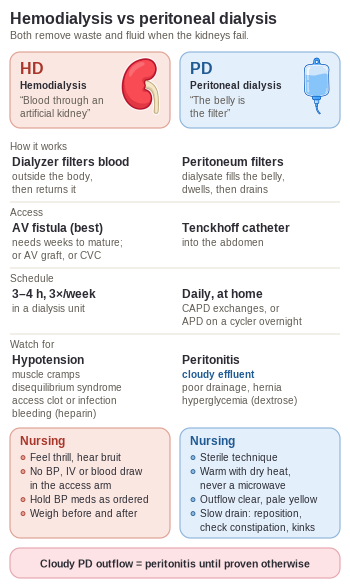
Hemodialysis vs Peritoneal Dialysis
- AV fistula preferred; AV graft or central venous catheter may be used.
- Tenckhoff catheter into the peritoneal cavity.
- Usually 3 sessions/week, about 3-5 hours each.
- Multiple daily exchanges or overnight cycler therapy.
- Dialysis center, hospital, or selected home programs.
- Home, work, or travel if the patient/caregiver can perform sterile technique.
- Moderate protein loss through treatment.
- Higher ongoing protein loss into dialysate.
Overview
Hemodialysis (HD) uses an extracorporeal circuit 3×/week. Hold most BP meds before HD to avoid hypotension.
Overview
Dialysis replaces part of kidney excretory function by removing waste, extra fluid, and some electrolytes.
Assessment Findings
For PD patients, cloudy effluent is always peritonitis until proven otherwise.
- Before and after HD, assess weight, BP, edema, lung sounds, access bruit/thrill, and symptoms of hypotension or cramps.
- PD assessment includes abdominal pain, fever, exit-site redness, drainage, and dialysate clarity.
- Cloudy PD effluent suggests peritonitis until proven otherwise.
Diagnostics
Anemia is expected and managed separately.
- Monitor potassium, BUN/creatinine, bicarbonate, phosphorus, calcium, hemoglobin, albumin, and adequacy measures.
- Culture cloudy peritoneal effluent when infection is suspected.
- Assess access flow and signs of stenosis, clotting, or infection.
Treatment
Neither is superior overall — both achieve adequate clearance when done consistently.
- Hemodialysis usually occurs several times per week through AV fistula, graft, or catheter.
- Peritoneal dialysis exchanges dialysate into and out of the abdomen manually or by cycler.
- Medications may need timing adjustments because some are removed by dialysis.
Nursing Priorities
Absent bruit or thrill is a vascular emergency requiring immediate provider notification.
- Weigh before and after HD and monitor for hypotension during treatment.
- Protect AV access from BP cuffs, blood draws, and IVs; assess bruit and thrill.
- Use sterile technique for PD connections and monitor effluent clarity.
Patient Teaching
Dialysis patients must self-manage between sessions — strict adherence to diet, fluid limits, and medications directly determines whether they arrive to treatment in a stable or compromised state.
- Report absent bruit/thrill, bleeding, fever, access redness, cloudy PD effluent, or severe abdominal pain.
- Follow diet, fluid, medication, and schedule instructions closely.
- Avoid sleeping on or carrying heavy objects over an AV fistula arm.
Complications
The complications of each modality differ in timing and acuity: HD complications tend to occur during or immediately after the session, while PD complications (especially peritonitis) develop over hours to days and require the patient to recognize and report warning signs.
- HD: hypotension, disequilibrium syndrome, bleeding, access thrombosis, infection, and electrolyte shifts.
- PD: peritonitis, exit-site infection, hernia, hyperglycemia, and inadequate clearance.
HD Complications
First sessions are intentionally short to prevent this.
- Disequilibrium syndrome: too-rapid fluid and electrolyte removal can cause cerebral edema with headache, nausea, confusion, seizure, or coma; slow initial sessions reduce risk.
- Hypotension: rapid ultrafiltration and vasodilation can drop BP; hold antihypertensives and vasodilators before HD when ordered.
- Muscle cramps: rapid fluid removal can trigger painful cramping during treatment.
- Clotted fistula or graft: absent bruit/thrill, poor flow, swelling, or prolonged bleeding needs urgent evaluation.
Peritonitis in PD
Peritonitis is a peritoneal dialysis emergency because infection can rapidly compromise the membrane used for dialysis and progress to sepsis.
Hemodialysis vs Peritoneal Dialysis
| Hemodialysis (HD) | Peritoneal Dialysis (PD) | |
|---|---|---|
| Access | AV fistula preferred; AV graft or central venous catheter may be used. | Tenckhoff catheter into the peritoneal cavity. |
| Duration | Usually 3 sessions/week, about 3-5 hours each. | Multiple daily exchanges or overnight cycler therapy. |
| Location | Dialysis center, hospital, or selected home programs. | Home, work, or travel if the patient/caregiver can perform sterile technique. |
| Protein loss | Moderate protein loss through treatment. | Higher ongoing protein loss into dialysate. |
| Infection risk | Access infection and bloodstream infection, especially with catheters. | Peritonitis and exit-site infection. |
| Contraindications | Severe hemodynamic instability may limit tolerance; lack of usable vascular access delays chronic HD. | Extensive abdominal scars, large hernia, inability to perform sterile exchanges, inflammatory bowel disease, or frequent diverticulitis. |
| Pros | Rapid solute/fluid removal, staff-performed care, medical help available quickly. | Greater independence, flexible schedule, less rapid fluid shifts, often fewer diet restrictions. |
| Cons | Travel schedule, needles, strict fluid/diet limits, hypotension/cramps, access complications. | Daily responsibility, storage space, peritonitis risk, glucose absorption/weight gain, hernia risk. |
Nursing priorities
- 1. Obtain pre-HD and post-HD weights and compare with dry weight. — Weight drives the ultrafiltration goal and helps evaluate fluid removal accuracy.
- 2. Hold antihypertensives and vasodilators on HD days when ordered. — Dialysis removes fluid and can cause hypotension during treatment.
- 3. Assess PD effluent color every exchange: clear is normal, cloudy suggests peritonitis, and blood-tinged may be expected during the first few exchanges. — Cloudy drainage is often the earliest actionable sign of PD peritonitis.
Key nursing points
- Weigh patient before AND after dialysis to assess fluid removal.
- Hold antihypertensives + water-soluble vitamins before HD.
- PD: cloudy effluent = peritonitis (the #1 complication).
- Disequilibrium syndrome: H/A, N/V, confusion — too-rapid solute shifts.
- Diet on dialysis: high protein (lost in dialysate), low K, low Na, low phos.
Test yourself

Pick your answer first, then open the rationale. Guessing teaches nothing.
Removes waste, fluid, electrolytes when kidneys fail.
— 3 —