Neurological Assessment
Systematic neurological assessment including level of consciousness, cranial nerves, motor strength, reflexes, and cerebellar function.
- Lesson 2 of 3
- 7 min read
Overview
Frequent comparison to baseline is essential — subtle changes can signal herniation or stroke before dramatic symptoms appear.
Level of consciousness is the early warning
A change in level of consciousness is often the earliest sign of neurologic deterioration.
- Use AVPU for a quick screen: alert, responds to voice, responds to pain, unresponsive.
- Use Glasgow Coma Scale for trendable detail: eye, verbal, motor, and total score.
- Check oxygen saturation and blood glucose when mental status changes suddenly.
- Report decreasing responsiveness, new agitation, seizure activity, or inability to protect the airway.
Pupils and cranial nerve clues
Pupil size, equality, and reactivity are high-value bedside findings.
- Assess pupils for size in millimeters, equality, shape, and reaction to light.
- Screen extraocular movements with an H pattern and ask about double vision.
- Check facial symmetry, speech clarity, swallow safety, shoulder shrug, and tongue midline.
- Document time of onset for new focal findings because stroke decisions are time dependent.
Motor, sensory, and cerebellar testing
Neurologic assessment is mostly comparison: left to right, upper to lower, and current to baseline.
- Grade strength from 0 to 5 and describe drift, tremor, spasticity, or flaccidity.
- Assess light touch, pain, numbness, tingling, and neglect in each extremity.
- Test coordination with finger-to-nose, heel-to-shin, gait, and balance when safe.
- New ataxia, unilateral weakness, saddle anesthesia, or bowel/bladder loss needs urgent escalation.
Posturing, reflexes, and ICP red flags
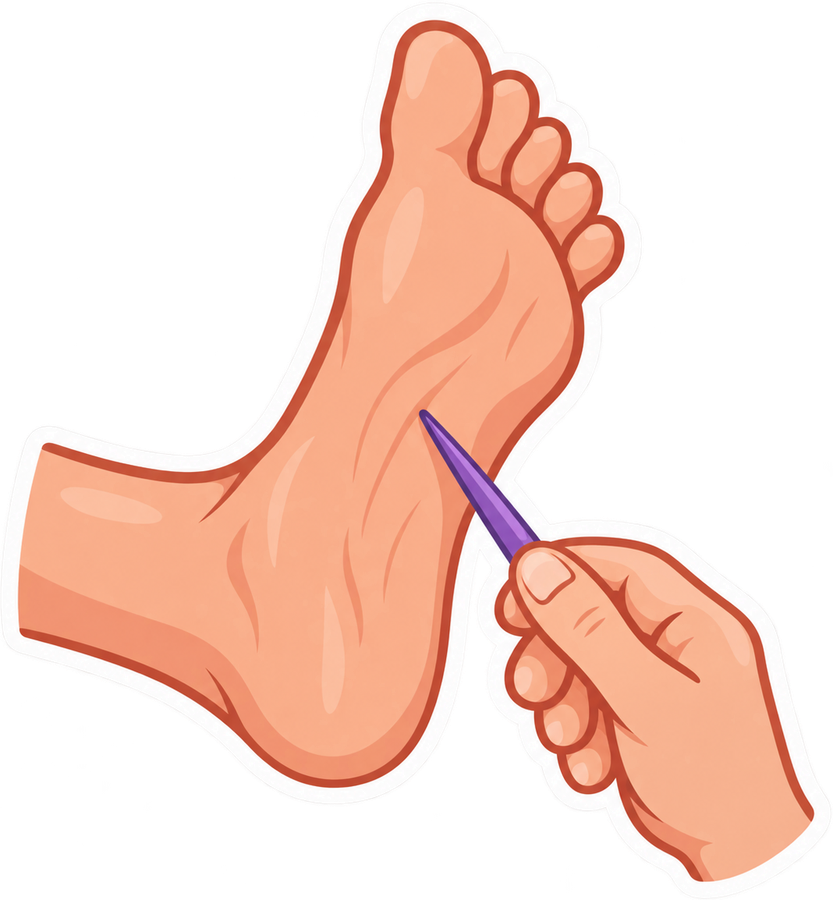
Abnormal posturing, a positive Babinski sign in an adult, worsening headache, vomiting, bradycardia with widened pulse pressure, or declining LOC can signal increased intracranial pressure.
- Decorticate: arms flexed, legs extended; indicates cortical pathway injury.
- Decerebrate: arms and legs extended; indicates more severe brainstem involvement.
- Adult Babinski response: great toe dorsiflexion with toe fanning is abnormal.
- Maintain airway and oxygenation while notifying the provider or rapid response team.
Safety and nursing priorities
Neurologic patients can deteriorate quickly from hypoxia, hypoglycemia, bleeding, edema, seizures, aspiration, or medication effects.
- Institute seizure precautions when indicated: padded side rails, suction, oxygen, and bed low.
- Keep NPO until swallow safety is confirmed after stroke symptoms or decreased LOC.
- Avoid sedating medications before neurologic checks unless ordered for a clear indication.
- Escalate any new deficit, not just a low GCS total.
Key nursing points
- GCS: Eye (1–4) + Verbal (1–5) + Motor (1–6) = 3–15. Score ≤ 8 = severe; consider intubation.
- LOC: most sensitive early indicator of neurological change.
- Pupils: size, equality, and reactivity — unequal pupils (anisocoria) may indicate herniation.
- Motor strength grading: 0 (no movement) to 5/5 (full strength against resistance).
- Abnormal posturing: decorticate (arms flexed, legs extended = cortical damage) vs decerebrate (all extension = brainstem damage — worse prognosis).
- Babinski sign: dorsiflexion of great toe + fan of toes = abnormal in adults (indicates UMN lesion).
- Key change to report: sudden decrease in LOC, new pupil inequality, new focal weakness.
Test yourself

Pick your answer first, then open the rationale. Guessing teaches nothing.
Systematic neurological assessment including level of consciousness, cranial nerves, motor strength, reflexes, and cerebellar function.
— 2 —