Key pointOrder: 1 g/hr. Have: 500 mg/250 mL. -> (1000 mg/hr) x (250 mL / 500 mg) = 500 mL/hr
Convert grams to milligrams first so units match: 1 g = 1000 mg. Then mg cancels and mL/hr remains.
Key nursing points
Setup
Cancel units diagonally
Always write out units
Works for
Example
Key nursing points
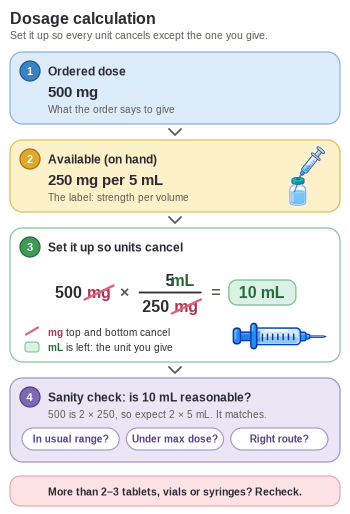
Setup: desired unit = given × (conversion fractions).
Cancel units diagonally — units in numerator cancel with same unit in denominator.
Always write out units — do not skip. The math checks itself when units cancel correctly.
Works for: oral dosing, IV rates, weight-based dosing, drip rates, all scenarios.
Example: ordered 500 mg, available 250 mg/5 mL. Answer: (500 mg) × (5 mL / 250 mg) = 10 mL.
Cross-check: the final unit should match what you need (mL for liquid, tablets for oral, mL/h for IV).
⚠EXAM TRAPCommon exam trapNCLEX: always verify the answer makes clinical sense. If an oral dose calculation gives you >3 tablets, recheck. If an IV rate gives you >300 mL/h without a special order, recheck. Unit errors are the leading cause of drug dosage errors in practice.
Test yourself?
Test yourself
Pick your answer first, then open the rationale. Guessing teaches nothing.
Question 1 of 3
A nurse is to administer morphine 4 mg IV. The available concentration is 10 mg/mL. Using dimensional analysis, how many mL should be given?
Answer: 0.4 mL Dimensional analysis: 4 mg × (1 mL/10 mg) = 4/10 mL = 0.4 mL. Units cancel: mg × (mL/mg) = mL. Dimensional analysis is preferred because it prevents unit errors — keep setting up fractions until only the desired unit remains. Always double-check opioid calculations.
Question 2 of 3
A provider orders IV fluids at 125 mL/hr. The tubing drop factor is 15 gtt/mL. What is the correct gravity flow rate in drops per minute?
A 60 kg patient is ordered dopamine at 5 mcg/kg/min. The pharmacy provides dopamine 400 mg in 250 mL D5W. At what rate in mL/hr should the infusion pump be set?
Answer: 11.25 mL/hr Step 1: Concentration = 400 mg/250 mL = 1.6 mg/mL = 1600 mcg/mL. Step 2: Dose = 5 mcg/kg/min × 60 kg = 300 mcg/min. Step 3: Convert to per hour = 300 × 60 = 18,000 mcg/hr. Step 4: Rate = 18,000 mcg/hr ÷ 1600 mcg/mL = 11.25 mL/hr. Dimensional analysis ensures correct unit cancellation at each step.
In one line
Unit cancellation method — set up fractions so unwanted units cancel, desired unit remains.
— 3 —
Finish lesson
Save your completion
Sign in to record progress, sync completion, and keep your study streak accurate.