Maslow's Hierarchy of Needs
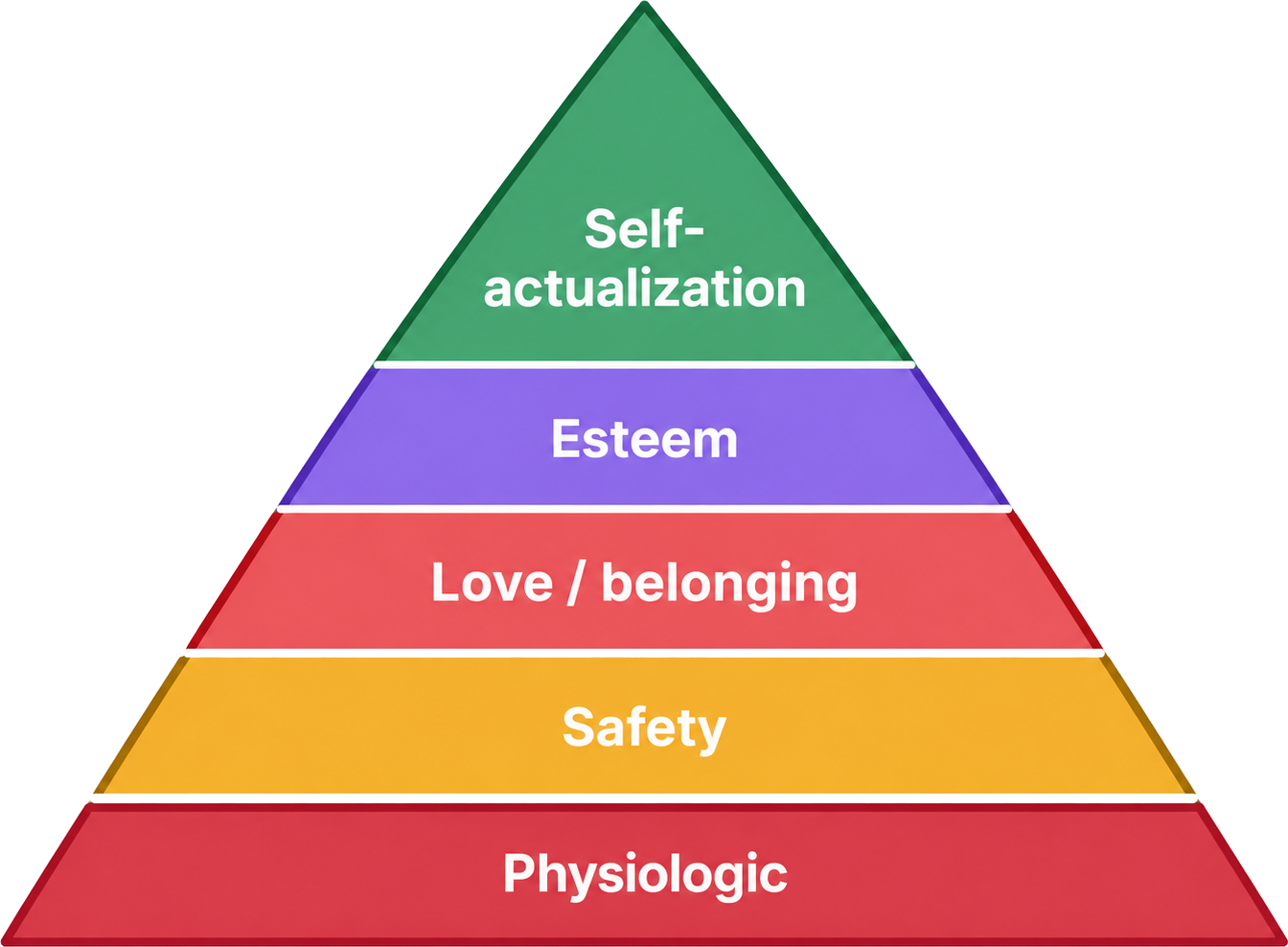
Prioritize physiologic > safety > love/belonging > esteem > self-actualization.
- Lesson 2 of 7
- 3 min read
5-tier hierarchy
Self-actualizationpurpose, goals, growth, meaning.
Esteemdignity, independence, body image, respect.
Love/belongingfamily connection, isolation, support systems.
Safetyfall prevention, restraints only when justified, seizure precautions, abuse protection, infection prevention.
Physiologicairway, breathing, circulation, oxygenation, fluids, nutrition, elimination, temperature, sleep.
Overview
In nursing, always meet lower-level needs first — a patient cannot focus on esteem if they can't breathe.
Meaning for Nursing Prioritization
Maslow's hierarchy ranks needs from most basic to most complex.
Use Maslow With ABCs
NCLEX tipMaslow does not replace ABCs; ABCs are physiologic needs.
Airway, breathing, and circulation sit inside the physiologic level and are usually the top priority when unstable.
- Airway threat: choking, stridor, facial burns, angioedema, decreased consciousness with secretions.
- Breathing threat: severe hypoxia, cyanosis, respiratory distress, absent breath sounds.
- Circulation threat: active hemorrhage, chest pain with instability, hypotension with altered mentation.
- Safety can be first when physiology is stable but harm is immediate, such as active seizure or suicide plan.


Assessment Cues in Questions
Prioritization questions often hide the answer in words like new, sudden, severe, increasing, decreased level of consciousness, or unable.
- Acute changes outrank chronic expected findings.
- Actual problems generally outrank potential problems.
- Unstable patients outrank stable patients.
- Unexpected postoperative findings outrank expected discomfort.
- A patient who cannot protect themself may outrank one who can call for help.

Common NCLEX Traps
NCLEX answer choices may all sound compassionate.
- Do not choose discharge teaching before treating hypoxia, bleeding, or unstable vital signs.
- Do not choose pain reassessment over an airway or breathing emergency.
- Do not choose family notification before immediate patient stabilization.
- Do not choose self-esteem support before safety in a confused patient trying to climb out of bed.
Key nursing points
- Physiologic: airway, breathing, circulation, food, water, sleep.
- Safety: physical safety, security, freedom from fear.
- Love/belonging: family, friendships, intimacy.
- Esteem: respect, recognition, achievement.
- Self-actualization: meaning, creativity, fulfillment.
EXAM TRAPCommon exam trapWhen in doubt on NCLEX, pick the answer addressing ABCs first — even before pain control, teaching, or emotional support. Pain is important but does not outrank airway or circulation. Safety (level 2) can take priority if the physiologic needs are met and a patient is actively in danger.
Test yourself

Pick your answer first, then open the rationale. Guessing teaches nothing.
In one line
Prioritize physiologic > safety > love/belonging > esteem > self-actualization.
— 2 —