Writing a Nursing Care Plan (NCP)
NANDA diagnosis → measurable outcomes (NOC) → nursing interventions (NIC) → evaluation. The NCP is ADPIE applied to a specific patient problem.
- Lesson 7 of 7
- 6 min read
4 terms
- Three-part format
- PROBLEM (the NANDA label) + RELATED TO (etiology/cause) + AS EVIDENCED BY (objective and subjective data).
- Example
- 'Acute pain r/t tissue injury from surgical incision AEB pain rating 8/10, guarding behavior, and reluctance to cough.'
- Risk diagnoses
- two-part format — 'Risk for [problem] r/t [risk factors].' No AEB because the problem hasn't occurred yet.
- Health promotion diagnoses
- 'Readiness for enhanced [behavior]' — when the patient wants to improve a healthy behavior.
Overview
A nursing care plan (NCP) documents the nurse's individualized plan for addressing a patient's health problems.
Structure of a Nursing Care Plan
A nursing care plan is ADPIE written for one patient problem.
The plan should be individualized.
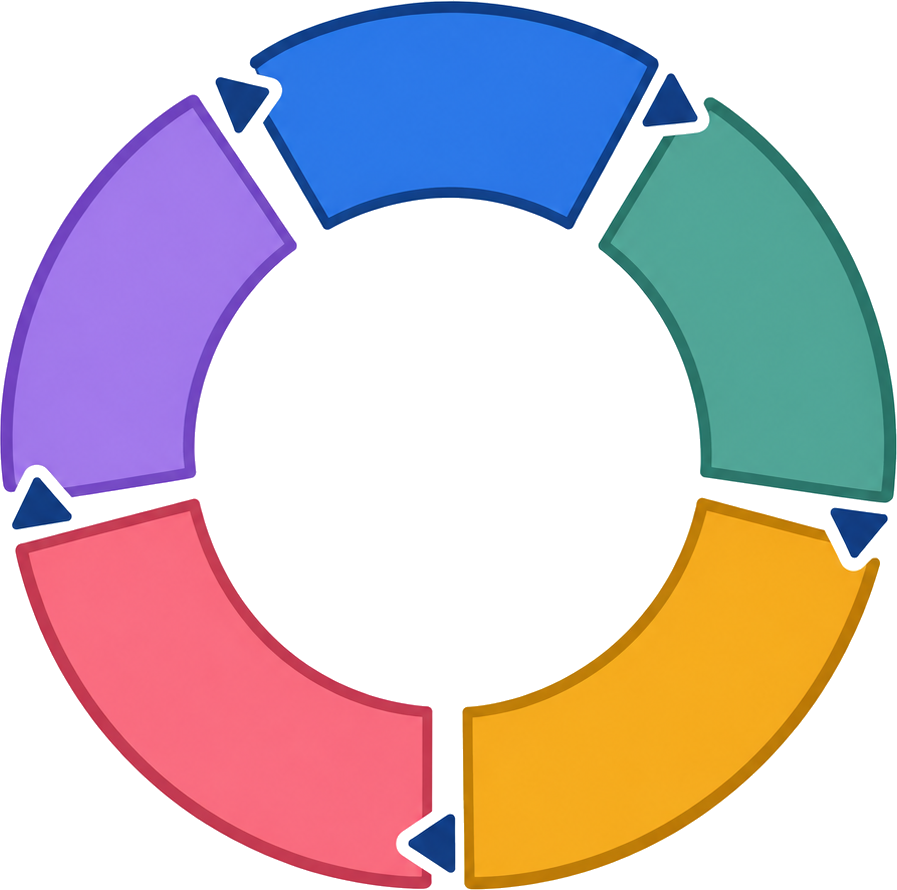 ADPIE
| NCP Component | What It Contains | NCLEX Key Point |
|---|---|---|
| Nursing Diagnosis | NANDA label + related factors (r/t) + defining characteristics (AEB) | Must reflect a HUMAN RESPONSE to a health problem — not a medical diagnosis |
| Patient Outcomes / Goals (NOC) | Measurable, time-bound statements of what the patient will achieve | Must be PATIENT-centered ('patient will...'), not nurse-centered ('nurse will...') |
| Nursing Interventions (NIC) | Specific actions the nurse will take to help the patient meet the outcomes | Include rationale for each intervention; distinguish independent vs. dependent |
| Evaluation | Comparison of actual patient status against the expected outcomes | State whether outcome was met, partially met, or not met — and revise if needed |
NANDA Nursing Diagnosis Format
A nursing diagnosis names the patient's response to a condition, not the medical disease itself.
Risk diagnoses do not include evidence because the problem has not occurred yet.
- Three-part format: PROBLEM (the NANDA label) + RELATED TO (etiology/cause) + AS EVIDENCED BY (objective and subjective data).
- Example: 'Acute pain r/t tissue injury from surgical incision AEB pain rating 8/10, guarding behavior, and reluctance to cough.'
- Risk diagnoses: two-part format — 'Risk for [problem] r/t [risk factors].' No AEB because the problem hasn't occurred yet.
- Health promotion diagnoses: 'Readiness for enhanced [behavior]' — when the patient wants to improve a healthy behavior.
- Do NOT write a nursing diagnosis that is a medical diagnosis: 'Pneumonia' is a medical diagnosis. The nursing diagnosis would be 'Impaired gas exchange r/t fluid accumulation in alveoli AEB SpO₂ 91%, crackles.'
 PROBLEMImpaired gas exchangeRELATED TOalveolar hypoventilationAS EVIDENCED BYSpO₂ 88%, RR 28, accessory muscles
Common High-Priority NANDA Diagnoses for NCLEX
Priority nursing diagnoses are ranked by threat to life and likelihood of deterioration.
A label such as anxiety may be true, but a diagnosis supported by SpO2 88%, absent pulses, new confusion, or uncontrolled bleeding is the safer priority.
- Ineffective airway clearance — always priority when airway is at risk.
- Impaired gas exchange — altered oxygenation.
- Decreased cardiac output — hemodynamic compromise.
- Acute pain — must assess and manage; remember pain is the 5th vital sign.
- Risk for infection — post-surgical, immunocompromised, lines/tubes.
- Deficient fluid volume — hemorrhage, diarrhea, vomiting, diaphoresis.
- Ineffective tissue perfusion — peripheral, cerebral, renal, cardiopulmonary.
- Impaired skin integrity / Risk for pressure injury — immobility, malnutrition, incontinence.
- Deficient knowledge — patient teaching needed.
- Anxiety — emotional/psychological response to illness.


Writing Patient Outcomes (Goals)
They must be patient-centered, measurable, realistic for the patient's condition, and tied directly to the nursing diagnosis.
A goal that cannot be measured cannot be evaluated.
- Goals must be PATIENT-centered — written in terms of what the patient will do, feel, or demonstrate.
- SMART criteria: Specific ('will rate pain ≤3/10'), Measurable (not 'will feel better'), Achievable (realistic for this patient), Relevant, and Time-bound ('within 1 hour of analgesic administration').
- Wrong: 'Nurse will manage patient's pain.' Right: 'Patient will report pain ≤3/10 within 1 hour of administering ordered analgesic.'
- Short-term goals address immediate needs (within the shift or 24 hours). Long-term goals address discharge or rehabilitation outcomes.

Nursing Interventions & Rationale
'Monitor' is weak unless it states what to monitor, how often, what finding requires action, and why the action supports the outcome.
Rationales show nursing judgment.
- Independent interventions: actions the nurse can perform without a medical order (positioning, teaching, hygiene, ambulation support, emotional support).
- Dependent interventions: require a medical order to perform (administering medications, IV fluids, wound care per protocol).
- Collaborative interventions: require coordination with another provider (referral to PT/OT/dietitian, respiratory therapy, social work).
- Every intervention must have a rationale — the evidence-based reason WHY this action helps achieve the outcome.




Key nursing points
- Nursing diagnosis format: Problem r/t Etiology AEB (as evidenced by) Signs/Symptoms.
- Example: 'Impaired gas exchange r/t alveolar hypoventilation AEB SpO₂ 88%, RR 28, use of accessory muscles.'
- Outcomes (NOC) must be SMART: Specific, Measurable, Achievable, Realistic, Time-bound.
- Interventions (NIC) include independent (nurse can do alone), dependent (require MD order), and collaborative.
- Evaluation uses the outcome criteria — met, partially met, or not met. Modify the plan as needed.
- Medical diagnosis (pathology) ≠ nursing diagnosis (patient response to illness).
Test yourself

Pick your answer first, then open the rationale. Guessing teaches nothing.
NANDA diagnosis → measurable outcomes (NOC) → nursing interventions (NIC) → evaluation. The NCP is ADPIE applied to a specific patient problem.
— 7 —