ABG Interpretation (ROME)
pH, CO₂, HCO₃ — find the primary problem and the compensation.
- Lesson 6 of 8
- 6 min read
Mnemonic · ROME
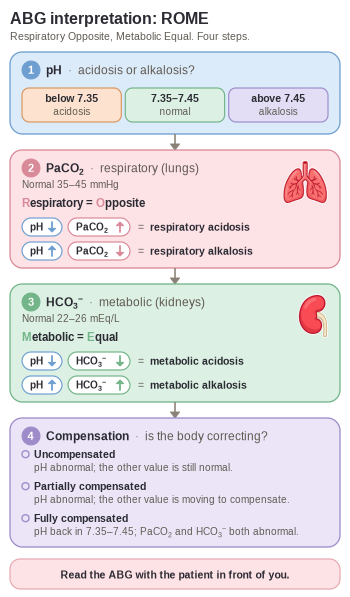
ROME
- RRespiratory
- OOpposite
- MMetabolic
- EEqual
Overview
ABGs measure oxygenation, ventilation, and acid-base balance at the same time.
Normal ABG Values
PaCO2 reflects ventilation and the respiratory component. HCO3 reflects the metabolic buffer controlled mainly by the kidneys.

Normal ABG reference ranges
| Parameter | Normal range | What it measures |
|---|---|---|
| pH | 7.35-7.45 | Overall blood acidity or alkalinity |
| PaCO2 | 35-45 mmHg | Respiratory acid level; ventilation and CO2 removal |
| HCO3 | 22-26 mEq/L | Metabolic base buffer regulated mainly by the kidneys |
| PaO2 | 80-100 mmHg | Oxygen dissolved in arterial blood |
| SpO2 | 95-100% | Hemoglobin saturation measured by pulse oximetry |
ROME Method
In metabolic disorders, pH and HCO3 move in the same direction because bicarbonate is a base.
A normal pH with abnormal PaCO2 or HCO3 may represent full compensation or a mixed disorder.
Step-by-Step Interpretation
Example 1: pH 7.28, PaCO2 55, HCO3 24. HCO3 is normal, so there is no metabolic compensation yet.
Example 2: pH 7.50, PaCO2 30, HCO3 22. HCO3 is still normal, so compensation has not occurred.
Fully compensated means pH has returned to 7.35-7.45, but PaCO2 and HCO3 remain abnormal and show the underlying problem.
ABG Patterns Table
A COPD patient with rising PaCO2 and decreasing level of consciousness is a respiratory emergency.
Primary and compensated ABG patterns
| Condition | pH | PaCO2 | HCO3 | Compensation | Cause |
|---|---|---|---|---|---|
| Respiratory acidosis | Low | High | Normal | None | COPD, hypoventilation, airway obstruction, oversedation |
| Partially compensated respiratory acidosis | Low | High | High | Kidneys retaining HCO3 | COPD or chronic hypoventilation with renal response |
| Fully compensated respiratory acidosis | Normal leaning low | High | High | Renal compensation complete | Chronic CO2 retention, often COPD |
| Respiratory alkalosis | High | Low | Normal | None | Hyperventilation, anxiety, pain, early hypoxemia |
| Partially compensated respiratory alkalosis | High | Low | Low | Kidneys excreting HCO3 | Persistent hyperventilation |
| Fully compensated respiratory alkalosis | Normal leaning high | Low | Low | Renal compensation complete | Chronic hyperventilation or high-altitude physiology |
| Metabolic acidosis | Low | Normal | Low | None | DKA, diarrhea, AKI, lactic acidosis |
| Partially compensated metabolic acidosis | Low | Low | Low | Lungs blowing off CO2 | DKA, sepsis/lactic acidosis, uremia, toxin ingestion |
| Fully compensated metabolic acidosis | Normal leaning low | Low | Low | Respiratory compensation complete | Chronic renal disease or ongoing metabolic acid load |
| Metabolic alkalosis | High | Normal | High | None | Vomiting, NG suction, loop diuretics |
| Partially compensated metabolic alkalosis | High | High | High | Lungs retaining CO2 | Vomiting, NG suction, diuretics with hypochloremia |
| Fully compensated metabolic alkalosis | Normal leaning high | High | High | Respiratory compensation complete | Chronic base excess |
Compensation Rules
Respiratory compensation changes ventilation and can begin within minutes to hours.
Mixed-disorder clues appear when compensation does not make physiologic sense: pH is normal but PaCO2 and HCO3 move in opposite acid-base directions, both PaCO2 and HCO3 push pH the same way, or the pH is more abnormal than expected for one primary disorder.
- Lungs compensate for metabolic disorders: fast response in minutes to hours by increasing or decreasing ventilation.
- Kidneys compensate for respiratory disorders: slow response over about 2-5 days by changing bicarbonate retention or excretion.
- Respiratory alkalosis -> kidneys excrete HCO3 to reduce alkalinity.
- Respiratory acidosis -> kidneys retain HCO3 to buffer retained CO2.
- Metabolic acidosis -> lungs increase rate/depth to blow off CO2; Kussmaul respirations are a classic DKA clue.
- Metabolic alkalosis -> lungs may hypoventilate to retain CO2, but hypoxemia limits how much respiratory compensation can occur.
Diagnostic tests
| Test | Purpose | Normal | Abnormal | Nursing note |
|---|---|---|---|---|
| Arterial Blood Gas (ABG) | Assess acid-base balance and oxygenation | pH 7.35-7.45, PaCO2 35-45, HCO3 22-26, PaO2 80-100 | Outside any normal range - interpret all values together | Allen's test before radial artery puncture. Hold pressure 5 min (10 min if on anticoagulants). Ice specimen immediately. |
Nursing priorities
- 1. Correlate ABG with the clinical picture. — Numbers without context are meaningless; oxygen device, work of breathing, mental status, disease history, and pulse oximetry determine urgency.
- 2. For respiratory acidosis, stimulate the patient, reposition, support ventilation, and prepare for intubation if deteriorating. — Rising PaCO2 with decreasing LOC means ventilation is failing and the airway may be lost.
- 3. For metabolic acidosis with a wide anion gap greater than 12, think DKA, lactic acidosis, toxins, or uremia. — The gap helps separate bicarbonate loss from dangerous unmeasured acids that need urgent cause-specific treatment.
Key nursing points
- Normal: pH 7.35-7.45, PaCO2 35-45, HCO3 22-26, PaO2 80-100, SpO2 95-100%.
- ROME: Respiratory Opposite, Metabolic Equal.
- High PaCO2 means hypoventilation or CO2 retention; low PaCO2 usually means hyperventilation.
- Low HCO3 points to metabolic acidosis; high HCO3 points to metabolic alkalosis.
- Compensation should move pH toward normal, but it does not erase the primary disorder.
Test yourself

Pick your answer first, then open the rationale. Guessing teaches nothing.
pH, CO₂, HCO₃ — find the primary problem and the compensation.
— 6 —