Tuberculosis (TB)
Airborne mycobacterium — long therapy, strict adherence.
- Lesson 5 of 8
- 5 min read
Overview
Active TB requires Airborne Precautions (N95, negative-pressure room). Treatment is 6–9 months of multi-drug therapy (RIPE).
Transmission and Latent vs Active
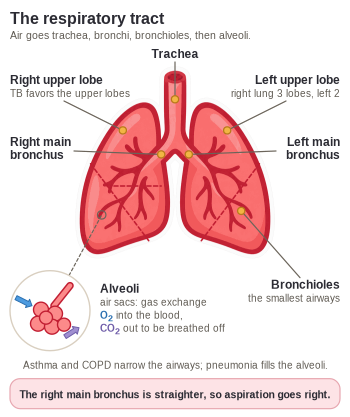
Tuberculosis spreads through airborne droplet nuclei smaller than 5 microns.
Latent TB means the immune system has contained the organism.
PPD/TST Interpretation
The tuberculin skin test is read by measuring induration, not redness.
Tuberculin skin test cutoffs
| Induration size | Population | Consider positive if: |
|---|---|---|
| 5 mm | HIV+, recent TB contact, transplant/immunosuppressed, chest x-ray changes consistent with prior TB | Induration is >= 5 mm |
| 10 mm | Foreign-born from high-prevalence area, IVDU, healthcare workers, prisoners, residents/employees of high-risk congregate settings, certain medical risks | Induration is >= 10 mm |
| 15 mm | Low-risk individuals | Induration is >= 15 mm |
Airborne Isolation Requirements
An N95 respirator is required because it filters at least 95% of airborne particles at that size.
- Place patient in a negative-pressure room.
- Staff wear fit-tested N95 respirator, not a surgical mask.
- Keep the door closed at all times except entry/exit.
- Patient wears a surgical mask when outside the room for essential transport.
- Use a room with minimum 12 air changes/hour when available per airborne-infection standards.
- Limit transport and notify receiving departments before movement.
Overview
Tuberculosis is an airborne infection caused by Mycobacterium tuberculosis.

Assessment Findings
Classic active TB presents as a constitutional syndrome: persistent productive cough (sometimes blood-tinged), drenching night sweats, low-grade fever, and unexplained weight loss over weeks to months.
- Persistent cough, hemoptysis, fever, night sweats, weight loss, fatigue, chest pain, and loss of appetite.
- Risk factors include close exposure, homelessness, incarceration, immunosuppression, HIV, diabetes, and residence or travel in high-prevalence areas.
- Assess medication history and symptoms of hepatotoxicity or visual changes during therapy.
Diagnostics
A positive PPD or IGRA indicates TB exposure — not active disease.
- Positive TB skin test or IGRA indicates exposure, not necessarily active disease.
- Chest x-ray and sputum acid-fast bacilli smear/culture help confirm active pulmonary TB.
- Baseline and follow-up liver function tests are important with RIPE therapy.
Treatment
Four-drug therapy (RIPE) is required because using fewer agents allows drug-resistant mutants to emerge and proliferate.
- Active TB is treated with multi-drug therapy, commonly RIPE during the intensive phase.
- Directly observed therapy improves adherence and reduces resistance.
- Drug-resistant TB requires longer specialist-guided regimens.
Nursing Priorities
Nursing plays the frontline DOT role in inpatient settings.
- Use airborne precautions: negative-pressure room, N95 respirator, and door closed.
- Collect sputum specimens as ordered and teach cough etiquette.
- Monitor for INH neuropathy, rifampin interactions, pyrazinamide hepatotoxicity/hyperuricemia, and ethambutol optic neuritis.
Patient Teaching
Orange-colored body fluids from rifampin alarm patients who were not warned — this harmless but vivid side effect is a common reason patients stop medication.
- Complete the full treatment course even when symptoms improve.
- Rifampin can turn urine, sweat, tears, and contact lenses orange-red.
- Report jaundice, dark urine, severe fatigue, abdominal pain, numbness/tingling, or vision changes.
Complications
Prevention through complete first-line therapy is the only viable strategy.
Nursing priorities
- 1. Collect 3 consecutive morning sputum AFB smears to confirm active TB status and support release from isolation per policy. — Morning specimens have higher organism yield and serial negative smears help determine infectiousness.
- 2. Use DOT: directly observed therapy, watching the patient swallow every dose. — Adherence prevents relapse, transmission, and drug resistance.
- 3. Report TB to public health. — TB is a reportable disease requiring contact investigation and community control measures.
Key nursing points
- Airborne precautions: N95 mask, negative-pressure room, door closed.
- RIPE drugs: Rifampin, Isoniazid, Pyrazinamide, Ethambutol.
- Isoniazid → give B6 (pyridoxine) to prevent neuropathy.
- Rifampin turns body fluids orange-red — teach patient, harmless.
- Ethambutol → optic neuritis, baseline + monthly vision checks.
Test yourself

Pick your answer first, then open the rationale. Guessing teaches nothing.
Airborne mycobacterium — long therapy, strict adherence.
— 5 —