Pneumonia
Alveolar infection — fever, productive cough, crackles, infiltrate on CXR.
- Lesson 3 of 8
- 5 min read
Overview
Older adults may present only with confusion. Get cultures BEFORE antibiotics whenever possible.
Classification
Hospital-acquired pneumonia begins at least 48 hours after admission. Ventilator-associated pneumonia begins at least 48-72 hours after intubation.
Common CAP organisms include Streptococcus pneumoniae as the classic number one bacterial cause, Mycoplasma pneumoniae as an atypical cause of walking pneumonia, Legionella from contaminated water or air-conditioning systems, and viral causes such as influenza and COVID-19.
Clinical Presentation by Lobe
Pneumonia findings vary with the amount and location of consolidation.
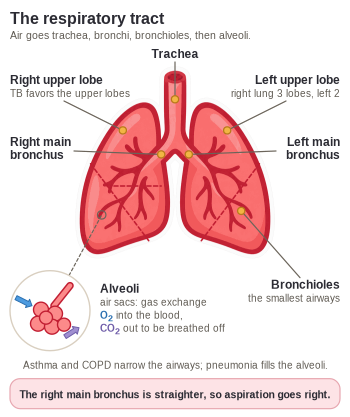
Focused lung findings
| Lobe | Percussion note | Breath sounds | Key symptom |
|---|---|---|---|
| RLL consolidation | Dull | Bronchial over affected area | Fever + productive cough |
| Atypical pattern | Resonant | Normal or scattered crackles | Dry cough, malaise, headache |
VAP Prevention Bundle
VAP prevention is a daily bedside bundle, not a single task.
Antibiotic Selection
Antibiotics depend on setting, severity, local resistance, allergy history, renal function, and MRSA or Pseudomonas risk.
Overview
Pneumonia is infection and inflammation of the lung parenchyma that fills alveoli with fluid or exudate.
Assessment Findings
The key NCLEX point for pneumonia assessment is recognizing atypical presentations in older adults — confusion, a fall, or a general decline may be the only signs, without classic fever or productive cough.
- Fever, chills, productive cough, pleuritic chest pain, dyspnea, tachypnea, crackles, decreased breath sounds, and fatigue.
- Older adults may present with confusion, weakness, falls, anorexia, or lower-than-expected fever.
- Aspiration pneumonia may follow dysphagia, vomiting, sedation, stroke, or decreased consciousness.
Diagnostics
The diagnostic priority is collecting cultures before antibiotics without delaying treatment — these goals are not in conflict.
- Chest x-ray may show infiltrates or consolidation.
- Obtain sputum and blood cultures before antibiotics when possible and not delaying treatment.
- Monitor CBC, SpO2, ABGs if severe, renal function for antibiotic dosing, and hydration status.

Treatment
Antibiotics kill the organism; pulmonary hygiene helps the lung clear the exudate.
- Antibiotics are selected by setting, severity, and likely organism.
- Supportive care includes oxygen if hypoxic, fluids if not contraindicated, antipyretics, bronchodilators if wheezing, and pulmonary hygiene.
- Aspiration risk management may require swallow evaluation and diet modification.
Nursing Priorities
Positioning and oxygenation are the first two interventions — semi-Fowler's or high Fowler's maximizes diaphragmatic excursion and reduces work of breathing.
- Maintain oxygenation, position upright, encourage cough/deep breathing, and use incentive spirometry.
- Administer antibiotics on schedule and reassess temperature, work of breathing, lung sounds, and SpO2.
- Prevent complications by early mobility, oral care, hydration, and aspiration precautions.
Patient Teaching
Completing the full antibiotic course even after symptoms resolve is the most important discharge teaching point — stopping early allows partially treated organisms to persist and create resistant strains.
- Complete antibiotics, increase fluids if allowed, rest, avoid smoking, and return for worsening dyspnea or fever.
- Promote influenza, COVID, and pneumococcal vaccination as appropriate.
Complications
Early recognition of sepsis criteria is a critical nursing responsibility.
Community-Acquired vs Hospital-Acquired Pneumonia
| CAP — Community-Acquired | HAP / VAP — Hospital or Ventilator-Acquired | |
|---|---|---|
| Definition | Pneumonia in a non-hospitalized patient OR within 48 hr of admission • Includes healthcare-associated (HCAP) in some guidelines | HAP: pneumonia ≥ 48 hr after hospital admission (not intubated) • VAP: pneumonia ≥ 48–72 hr after endotracheal intubation |
| Common organisms | Streptococcus pneumoniae (#1 cause) • Haemophilus influenzae • Atypicals: Mycoplasma (walking pneumonia), Legionella (water/AC systems), Chlamydophila • Viral: influenza, COVID-19 | Pseudomonas aeruginosa (most feared) • MRSA (Staphylococcus aureus) • Enterobacteriaceae (Klebsiella, E. coli) • Acinetobacter baumannii (ICU, especially war wounds) |
| Empiric antibiotics | Outpatient: azithromycin or doxycycline (low risk) or respiratory fluoroquinolone (high risk) • Inpatient non-ICU: beta-lactam + macrolide OR fluoroquinolone alone • ICU: anti-pneumococcal beta-lactam + macrolide/fluoroquinolone | Anti-pseudomonal beta-lactam (piperacillin-tazobactam, cefepime) + second anti-pseudomonal agent • Add vancomycin or linezolid if MRSA suspected (check nasal MRSA screen) • De-escalate based on culture results within 72 hr |
| Prevention | Pneumococcal vaccine (PCV15/PCV20 for adults ≥ 65 or high-risk) • Annual influenza vaccine • Hand hygiene, smoking cessation | VAP bundle: HOB 30–45°, daily sedation vacation + SBT • Oral chlorhexidine q12h, subglottic suctioning • Hand hygiene before and after circuit manipulation • Assess daily readiness to extubate |
Nursing priorities
- 1. Collect sputum culture before the first antibiotic dose when possible, but do not delay antibiotics waiting for results. — Cultures improve targeted therapy, while delayed antibiotics worsen outcomes in serious infection.
- 2. Assess oxygen needs: SpO2 < 94% often needs supplemental O2; SpO2 < 88% on 15 L NRB needs ICU/intubation evaluation. — Escalating oxygen requirement is an early marker of respiratory failure.
- 3. Encourage incentive spirometry 10 times per hour while awake. — Pulmonary expansion helps mobilize secretions and prevent atelectasis.
Key nursing points
- Hallmarks: fever, productive cough, pleuritic chest pain, crackles, ↑ WBC.
- Elderly red flag: new confusion may be the only sign.
- Cultures (sputum, blood) BEFORE first antibiotic dose.
- Position: semi-Fowler's, encourage coughing/deep breathing + incentive spirometer.
- Pneumococcal vaccine for adults ≥65 and high-risk groups.
Test yourself

Pick your answer first, then open the rationale. Guessing teaches nothing.
Alveolar infection — fever, productive cough, crackles, infiltrate on CXR.
— 3 —