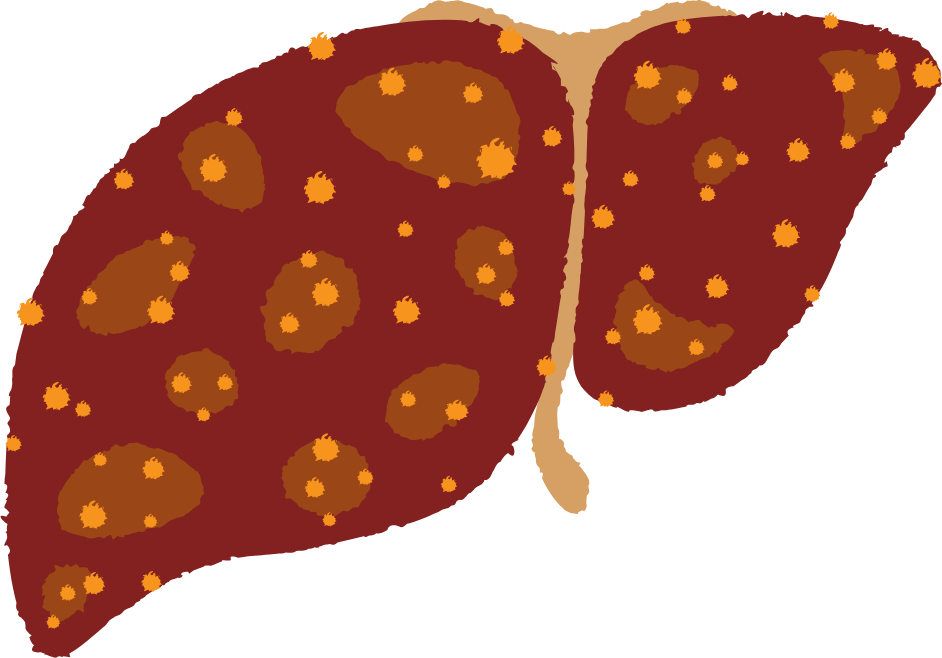
Cirrhosis is irreversible liver fibrosis that impairs detoxification, clotting, bile flow, metabolism, and portal blood flow.
Lesson 5 of 7
8 min read
Overview?
Overview
Nursing priorities include bleeding precautions, infection prevention, nutrition, medication safety, and monitoring for decompensation.
Cirrhosis is irreversible liver fibrosis that impairs detoxification, clotting, bile flow, metabolism,…
Pathophysiology?
1
Pathophysiology
Repeated injury replaces normal liver tissue with scar tissue and regenerative nodules.
Scar tissue and regenerative nodules replace working liver, so blood cannot pass through it. Portal pressure rises and hepatocyte function falls together.
Signs & Symptoms?
2
Signs & Symptoms
Cirrhosis findings depend on whether the liver is still compensating.
Medication sensitivity is common because hepatic metabolism is impaired.
Complications and Pathophysiology?
8
Complications and Pathophysiology
Portal hypertension causes venous back pressure that produces esophageal varices, ascites, and splenomegaly.
Complications Table?
9
Complications Table
This matters for NCLEX prioritization: variceal bleeding is circulation first, encephalopathy is neurologic safety and ammonia reduction, ascites is fluid and infection surveillance, and hepatorenal syndrome is a severe perfusion failure requiring escalation.
Band ligation and propranolol prevention; octreotide for acute bleeding.
Ascites
Portal hypertension plus low albumin shifts fluid into the abdomen.
Diuretics, low-sodium diet, paracentesis, and albumin when ordered.
Hepatic encephalopathy
Increased ammonia and impaired detoxification affect the brain.
Lactulose titrated to 2-4 stools/day plus rifaximin.
Spontaneous bacterial peritonitis
Infected ascitic fluid, often without a clear surgical source.
Third-generation cephalosporin plus IV albumin.
Hepatorenal syndrome
Severe liver disease triggers renal vasoconstriction and functional renal failure.
Liver transplant is the only definitive treatment.
Varices Bleeding Emergency?
10
Varices Bleeding Emergency
⚠EXAM TRAPWatch outGI bleed from esophageal varices: massive hematemesis. Priority: ABC, large-bore IV × 2, type and cross, octreotide drip, IV antibiotics (prophylactic for SBP), endoscopy for band ligation within 12 hrs. Balloon tamponade (Sengstaken-Blakemore tube) only if endoscopy unavailable or fails.
Ruptured varices are a hemorrhagic shock emergency.
Ruptured varices are haemorrhagic shock. Protect the airway, get large-bore access, and give blood products and octreotide before anything else.
Hepatic Encephalopathy Grading?
11
Hepatic Encephalopathy Grading
Hepatic encephalopathy is a trend diagnosis at the bedside.
Grade
Mental status
Asterixis
0
Normal mental status
Absent
1
Mild confusion or sleep changes
May be subtle or absent
2
Moderate confusion, disoriented
Present
3
Somnolent, incoherent
Often present if testable
4
Coma
Not testable
Nursing priorities?
12
Nursing priorities
1. Measure daily weight and abdominal girth at the same location every day; report > 1 kg/day gain.— Rapid gain suggests worsening ascites or fluid retention.
2. Teach no NSAIDs and no acetaminophen above 2 g/day unless specifically prescribed.— NSAIDs worsen renal perfusion and bleeding risk; excess acetaminophen is hepatotoxic in cirrhosis.
3. Titrate lactulose to 2-4 soft stools/day.— More stools can cause dehydration and electrolyte loss; fewer stools may not clear ammonia adequately.
Key nursing points
Compensated cirrhosis may have few…
Portal hypertension causes esophageal…
Bleeding risk rises because the liver…
Hepatic encephalopathy
Avoid alcohol and hepatotoxic drugs
Key nursing points
Compensated cirrhosis may have few symptoms; decompensated disease causes ascites, jaundice, variceal bleeding, and encephalopathy.
Portal hypertension causes esophageal varices, splenomegaly, ascites, and thrombocytopenia.
Bleeding risk rises because the liver cannot produce clotting factors and platelets may fall.
Avoid alcohol and hepatotoxic drugs; acetaminophen use requires provider-directed limits.
Report hematemesis, melena, confusion, fever, severe abdominal pain, or rapid weight gain.
⚠EXAM TRAPCommon exam trapAsterixis and confusion in cirrhosis indicate hepatic encephalopathy until proven otherwise. Variceal bleeding is an emergency, even if the patient says the nausea improved.
Test yourself?
Test yourself
Pick your answer first, then open the rationale. Guessing teaches nothing.
Question 1 of 7
A patient with cirrhosis and ascites becomes confused, disoriented, and develops a flapping tremor of the hands (asterixis). Serum ammonia is elevated. Which nursing intervention is the priority?
Answer: Administer lactulose as ordered and monitor the number and character of stools. Hepatic encephalopathy from elevated ammonia is treated with lactulose, which acidifies colonic contents, traps ammonia as ammonium ion, and eliminates it via stool; the goal is 2-3 soft stools per day. High dietary protein is contraindicated during acute encephalopathy because amino acid catabolism produces the ammonia driving the confusion.
Question 2 of 7
A patient with cirrhosis begins vomiting large amounts of bright red blood. The nurse suspects esophageal variceal hemorrhage. Which action should the nurse perform first?
Answer: Insert a large-bore IV and begin fluid resuscitation while calling for help. Esophageal variceal bleeding is a life-threatening emergency requiring immediate IV access, resuscitation, and team activation because hemorrhage can be massive and rapidly fatal in cirrhosis. A PPI alone is not effective for variceal bleeding, and waiting for labs before resuscitation is inappropriate in a hemodynamically unstable patient.
Question 3 of 7
A nurse is teaching a patient with compensated cirrhosis about medications. Which statement by the patient indicates a need for further teaching?
Answer: 'I can take 3 to 4 grams of acetaminophen daily because it is safer than aspirin for my stomach.' In cirrhosis, the liver's capacity to metabolize acetaminophen is impaired and standard doses can cause severe hepatotoxicity; provider-directed limits are typically much lower than 4 g/day. While NSAIDs should also be avoided due to GI and renal risks in cirrhosis, the acetaminophen misconception is the most immediately dangerous error in this statement.
Question 4 of 7
A client with cirrhosis and hepatic encephalopathy is prescribed lactulose 30 mL three times daily. The client asks why they need a 'laxative.' Which nurse explanation is most accurate?
Answer: 'Lactulose acidifies the colon, trapping ammonia in the stool and removing it from the body — we aim for 2 to 3 soft stools per day.' Lactulose converts ammonia (NH3) to ammonium (NH4+) in the acidified colon, preventing its absorption and elimination via stool; the therapeutic goal is 2 to 3 soft stools per day. Fewer stools indicate inadequate dosing; more than 5 watery stools per day signals overdose requiring dose reduction.
Question 5 of 7
A client with cirrhosis and 3+ pitting edema and massive ascites is admitted. Which initial management approach does the nurse anticipate?
Answer: Sodium restriction (2 g/day) combined with aldosterone-antagonist diuretics such as spironolactone First-line management of cirrhotic ascites is dietary sodium restriction to 2 g/day combined with spironolactone, which counteracts the secondary hyperaldosteronism driving sodium and water retention. Aggressive fluid restriction is not the primary intervention and can worsen renal perfusion; paracentesis is reserved for refractory or tense ascites.
Question 6 of 7
A patient with cirrhosis becomes confused and has asterixis. Which medication does the nurse anticipate?
Answer: Lactulose Confusion and asterixis suggest hepatic encephalopathy. Lactulose reduces ammonia by trapping it in the gut and promoting stool excretion.
Question 7 of 7
Which finding in cirrhosis is most urgent?
Answer: Vomiting bright red blood Hematemesis can indicate ruptured esophageal varices, a life-threatening hemorrhage requiring emergency intervention.
In one line
Cirrhosis is irreversible liver fibrosis that impairs detoxification, clotting, bile flow, metabolism, and portal blood flow.
— 5 —
Finish lesson
Save your completion
Sign in to record progress, sync completion, and keep your study streak accurate.