Fetal Heart Tones — VEAL CHOP
Decel pattern → cause → action.
- Lesson 3 of 16
- 5 min read
Overview
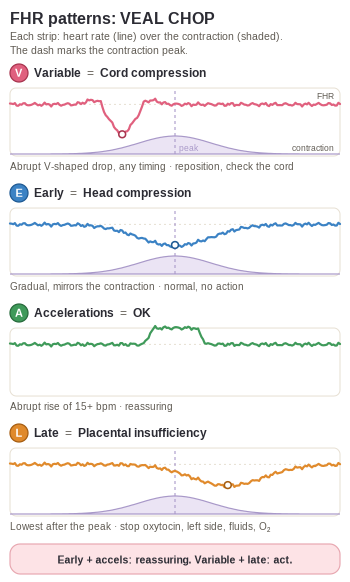
VEAL CHOP: Variable=Cord compression, Early=Head compression, Accelerations=Okay, Late=Placental insufficiency. Lates and prolonged variables are non-reassuring — act fast.
VEAL CHOP — The Pattern
Fetal heart tracing interpretation links the shape and timing of a deceleration to the likely oxygenation problem.
- V — Variable decelerations → C — Cord compression. Abrupt drop in FHR, varies in timing relative to contractions. Most common decel type.
- E — Early decelerations → H — Head compression. Gradual mirror-image of contraction, nadir at peak of contraction. NORMAL and benign — no action needed.
- A — Accelerations → O — Okay (fetal well-being). FHR rises ≥15 bpm × ≥15 sec. Reassuring. Reactive NST = 2 accelerations in 20 min.
- L — Late decelerations → P — Placental insufficiency. Gradual drop in FHR that BEGINS AFTER contraction peak and returns after contraction ends. NON-REASSURING — always requires intervention.
Interventions by Decel Type
Interventions reduce fetal stress while improving uteroplacental or cord blood flow.
- Variable decels: reposition mother (left lateral, knee-chest, or right lateral), supplemental O₂ 8–10 L via non-rebreather mask, IV fluid bolus, STOP Pitocin if infusing, notify provider. If severe/persistent → amnioinfusion (dilutes cord compression).
- Early decels: no intervention needed. Document and continue to monitor.
- Late decels: STOP Pitocin (first action) → reposition left lateral → O₂ 8–10 L NRB → IV fluid bolus → notify provider → prepare for possible emergency delivery.
- Prolonged deceleration (>2 min, <10 min): treat same as late decels aggressively. >10 min = baseline change.
Baseline & Variability
Normal fetal heart rate baseline is 110-160 bpm.
Absent or minimal variability can reflect fetal acidemia, CNS depression, magnesium/opioids, prematurity, fetal sleep cycle, or chronic hypoxia.
- Normal baseline FHR: 110–160 bpm. Tachycardia (>160): fever, infection, fetal hypoxia, drugs (beta-agonists, cocaine). Bradycardia (<110): cord prolapse, abruption, maternal hypotension.
- Variability (short-term beat-to-beat fluctuation): minimal (<5 bpm) or absent = concerning (hypoxia, acidosis, medications). Moderate variability (6–25 bpm) = most reassuring sign of fetal well-being.
- Sinusoidal pattern: smooth wave-like, fixed amplitude — associated with fetal anemia, severe hypoxia. Ominous — notify provider immediately.
- Category III (non-reassuring): sinusoidal OR absent variability WITH late decels, variable decels, or bradycardia → requires rapid evaluation and delivery preparation.
Nursing Response to Late Decelerations
Late decelerations mean fetal oxygenation is not recovering well after contractions.
Category Classification
FHR categories communicate fetal risk and urgency.
FHR tracing categories
| Category | FHR pattern | Action |
|---|---|---|
| I | Normal baseline, moderate variability, no late/variable decels; early decels or accelerations may be present | Continue routine monitoring |
| II | Indeterminate tracing that is not Category I or III | Evaluate cause, reposition, hydrate, increase monitoring, notify as indicated |
| III | Absent variability with recurrent late/variable decels or bradycardia, or sinusoidal pattern | Immediate intervention, stay with patient, prepare for urgent delivery |
VEAL-CHOP
| Deceleration Type (VEAL) | Cause (CHOP) | |
|---|---|---|
| Variable | Abrupt, V-shaped drop • Timing varies with contractions | Cord compression |
| Early | Gradual drop • Mirrors contraction | Head compression |
| Accelerations | FHR increases >=15 bpm x 15 sec after 32 weeks | OK/reassuring fetal oxygenation |
| Late | Gradual drop after peak of contraction • Returns after contraction ends | Placental insufficiency |
Nursing priorities
- 1. Document FHR category every 15 min in active labor and every 5 min in second stage. — Category changes identify fetal deterioration and guide escalation.
- 2. For variable decels, reposition to relieve cord compression and anticipate amnioinfusion if ordered. — Maternal position changes or fluid can reduce cord compression.
- 3. Treat Category III as an emergency: stay with patient, call provider, stop oxytocin, and prepare for delivery. — Category III patterns indicate abnormal fetal acid-base status risk.
Key nursing points
- Variable decels → reposition mother (left side), give O₂, amnioinfusion if ordered.
- Early decels → normal, mirror contraction, no intervention.
- Accelerations → reassuring, sign of fetal well-being.
- Late decels → STOP Pitocin, reposition, O₂ 10 L NRB, IV fluids, notify provider.
- Baseline FHR 110–160; loss of variability is concerning.
Test yourself

Pick your answer first, then open the rationale. Guessing teaches nothing.
Decel pattern → cause → action.
— 3 —