Stages of Labor
1st: dilation · 2nd: pushing · 3rd: placenta · 4th: recovery.
- Lesson 4 of 16
- 4 min read
4 steps
- 1Latent phase
- 2Active phase
- 3Transition
- 4Nursing
- 1 0–6 cm, irregular contractions 5–20 min apart, lasting 30–45 sec. Walking encouraged.
- 2 6–10 cm, contractions every 2–5 min, lasting 45–60 sec, more intense. IV access, continuous monitoring.
- 3 8–10 cm, very intense contractions q1–2 min. Nausea, shaking, urge to push — guide breathing.
- 4 monitor FHR and contractions, vaginal exams for progress, assess pain, provide support.
Overview
Stage 1 = onset of true labor → 10 cm. Stage 4 = first 1–4 hr postpartum.
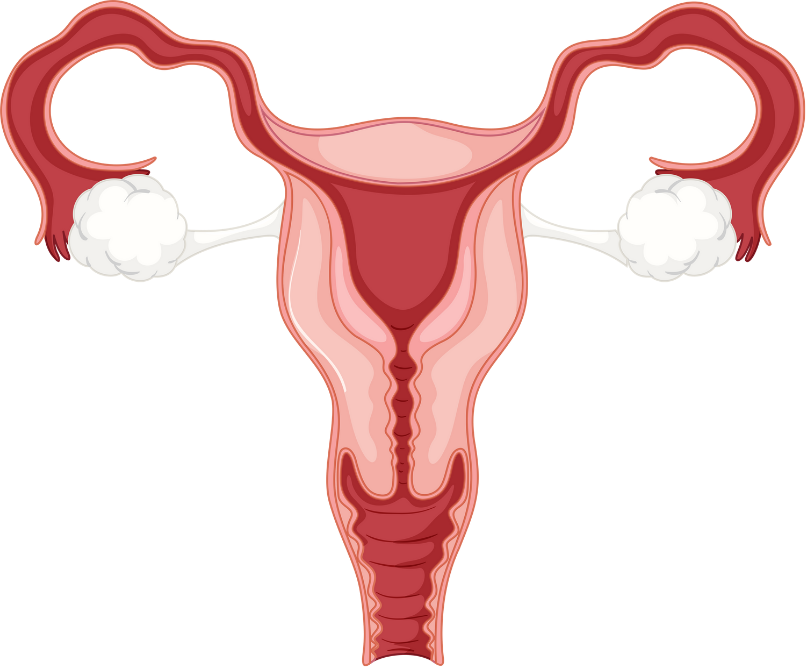
Labor Stages Overview
Labor staging helps nurses anticipate assessment frequency, fetal monitoring needs, pain support, and hemorrhage risk.
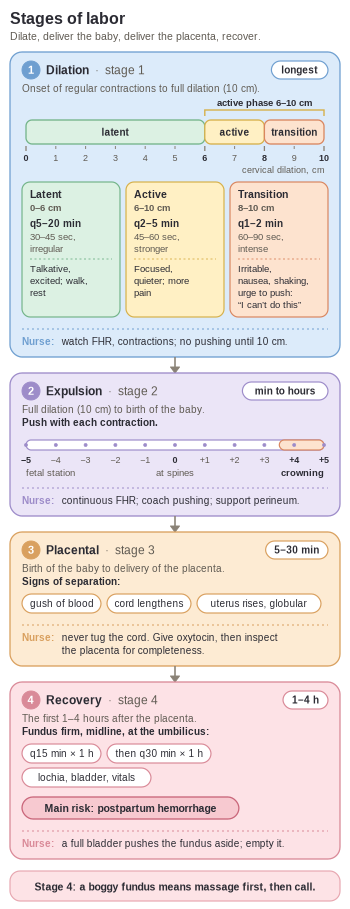
Stages and phases of labor
| Stage | Phase | Cervical dilation | Duration | Key nursing |
|---|---|---|---|---|
| Stage 1 | Latent | 0-6 cm | Longest phase; contractions often irregular | Promote rest, hydration, ambulation, coping, and admission assessment |
| Stage 1 | Active | 6-10 cm | Progress accelerates; about 1.5 cm/hr nullipara is a common benchmark | Monitor FHR/contractions, pain, coping, fluids, and labor progress |
| Stage 1 | Transition | 8-10 cm | Shortest and most intense part | Coach breathing, do not allow pushing until complete dilation, stay with patient |
| Stage 2 | Pushing/birth | 10 cm to birth | Minutes to hours | Monitor FHR closely, support pushing, prepare for birth |
| Stage 3 | Placenta | After birth | Placenta normally <=30 min | Watch for separation signs, give oxytocin, inspect placenta |
| Stage 4 | Recovery | First 1-2 hr postpartum | Highest immediate hemorrhage risk | Frequent fundus, lochia, bladder, vitals, pain, and perineum checks |
Stages Memory Aid
The stage number tells the nurse what risk to anticipate next: cervical progress, pushing and fetal tolerance, placental separation, then hemorrhage surveillance.
Stage 1 — Dilation
Stage 1 is about cervical change and fetal tolerance of contractions.
Abnormal Labor Patterns
Protracted labor means dilation or descent is slower than expected; arrested labor means no progress for about 2 hours in active labor despite adequate contractions.
Management begins with assessment of contractions, fetal position, pelvic adequacy, maternal fatigue, hydration, analgesia, and fetal status.
Pain Management Options
Pain control should support coping without masking fetal or maternal compromise.
Stage 2 — Pushing to Birth
Stage 2 is physically stressful for both mother and fetus because contractions and pushing temporarily reduce uteroplacental blood flow.
- Begins at full dilation (10 cm), ends with delivery of baby.
- Coach pushing with contractions; support perineum; prepare delivery equipment.
- Fetal descent monitored by station (−5 to +5; +4 to +5 = crowning).
- FHR monitored continuously — late decels during pushing = immediate intervention.
Stage 3 — Placenta
Controlled cord traction and oxytocin help prevent hemorrhage; if the placenta is retained longer than about 30 minutes, manual removal may be needed and the placenta must be inspected for completeness.
- From birth of baby to delivery of placenta — usually within 5–30 minutes.
- Signs of placental separation: gush of blood, cord lengthening, uterus rises and becomes globular.
- Never tug forcefully on the cord — retained placenta or uterine inversion risk.
- Inspect placenta for completeness — retained fragments cause postpartum hemorrhage.
- Oxytocin often given after delivery to promote uterine contraction and limit bleeding.
Stage 4 — Recovery
Stage 4 is the highest immediate-risk window for postpartum hemorrhage.
- First 1–4 hours after delivery: highest risk period for hemorrhage and complications.
- Fundal checks every 15 min × 1 hr, then every 30 min × 1 hr: fundus should be firm, midline, at umbilicus.
- Lochia rubra (red): expected for first few days; bright red or clots = abnormal.
- Assess bladder — full bladder displaces uterus laterally and prevents firm contraction.
- BUBBLE-HE assessment: Breasts, Uterus, Bladder, Bowel, Lochia, Episiotomy/lacerations, Homans sign, Emotions.
Labor Pain Options
| Epidural Analgesia | IV Opioids (Fentanyl/Morphine) | |
|---|---|---|
| Timing | Active labor when stable and no contraindications; can be used through birth. | Often used earlier or when epidural is not desired/available; avoid close to birth if neonatal depression risk. |
| Relief quality | Best pain relief; regional block with preserved awareness. | Systemic relief; decreases perception of pain but does not remove contraction sensation. |
| Effect on FHR | Maternal hypotension can reduce uteroplacental perfusion and cause FHR changes. | May reduce variability and cause neonatal respiratory depression if near delivery. |
| Side effects | Hypotension, urinary retention, fever, itching, motor block, prolonged second stage. | Sedation, nausea, dizziness, respiratory depression, newborn sedation. |
| Nursing monitoring | BP q5 min x 15 min after placement/bolus, FHR, level of block, bladder, fall risk. | Sedation, RR, SpO2, pain relief, timing of last dose before birth. |
Nursing priorities
- 1. Assess maternal BP every 5 min x 15 min after epidural placement or bolus. — Epidural-related hypotension can reduce uteroplacental perfusion; intervene with left lateral position and IV fluid as ordered.
- 2. Continuously monitor FHR when epidural and oxytocin are used. — Oxytocin tachysystole (>5 contractions/10 min) can cause fetal compromise and requires stopping the infusion.
- 3. Assess the perineum after delivery using REEDA. — Redness, Edema, Ecchymosis, Discharge, and Approximation identify laceration/episiotomy complications.
Key nursing points
- Stage 1 latent: 0–6 cm; active: 6–10 cm (fastest progress).
- Stage 2: pushing — watch perineum, prepare for delivery.
- Stage 3: placenta usually delivers within 30 min — check for completeness.
- Stage 4: assess fundus q15 min × 1 hr — firm, midline, at umbilicus.
- BUBBLE-HE postpartum: Breasts, Uterus, Bladder, Bowel, Lochia, Episiotomy, Homans, Emotions.
Test yourself

Pick your answer first, then open the rationale. Guessing teaches nothing.
1st: dilation · 2nd: pushing · 3rd: placenta · 4th: recovery.
— 4 —