Factor VIII (hemophilia A) or factor IX (hemophilia B) deficiency → prolonged bleeding.
Lesson 8 of 8
4 min read
Overview?
Overview
Hallmark: hemarthrosis (joint bleeding) causing pain and long-term joint damage.
What Hemophilia Is?
1
What Hemophilia Is
Hemophilia is an inherited clotting factor deficiency that prevents stable fibrin clot formation.
Platelet count is usually normal because the primary problem is the coagulation cascade.
aPTT is prolonged; PT is typically normal.
Severity depends on residual factor activity.
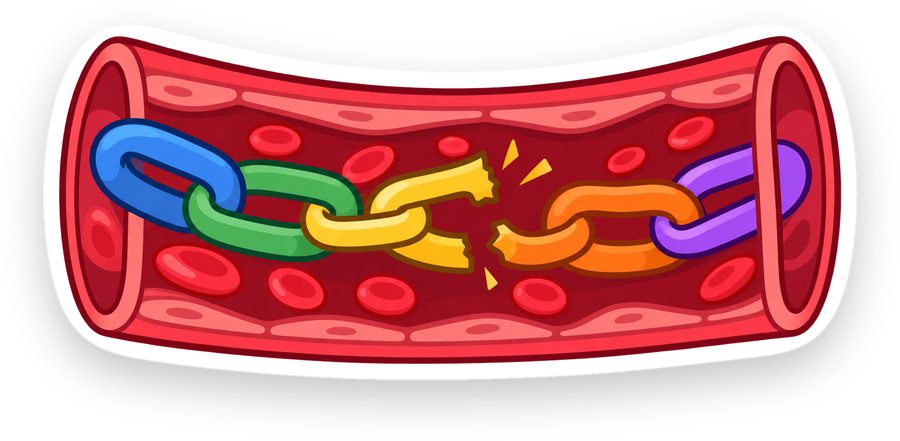
In haemophilia one clotting factor is missing, VIII in A and IX in B. The chain breaks and no stable clot forms. Platelets are normal.
Assessment Cues?
2
Assessment Cues
Prolonged bleeding after procedures, circumcision, dental work, trauma, or surgery.
Hemarthrosis: warm, swollen, painful joints, often knees, elbows, or ankles.
Deep muscle hematomas, large bruises, abdominal pain, flank pain, or compartment symptoms.
Head injury can cause delayed intracranial bleeding and is an emergency even if symptoms seem mild.
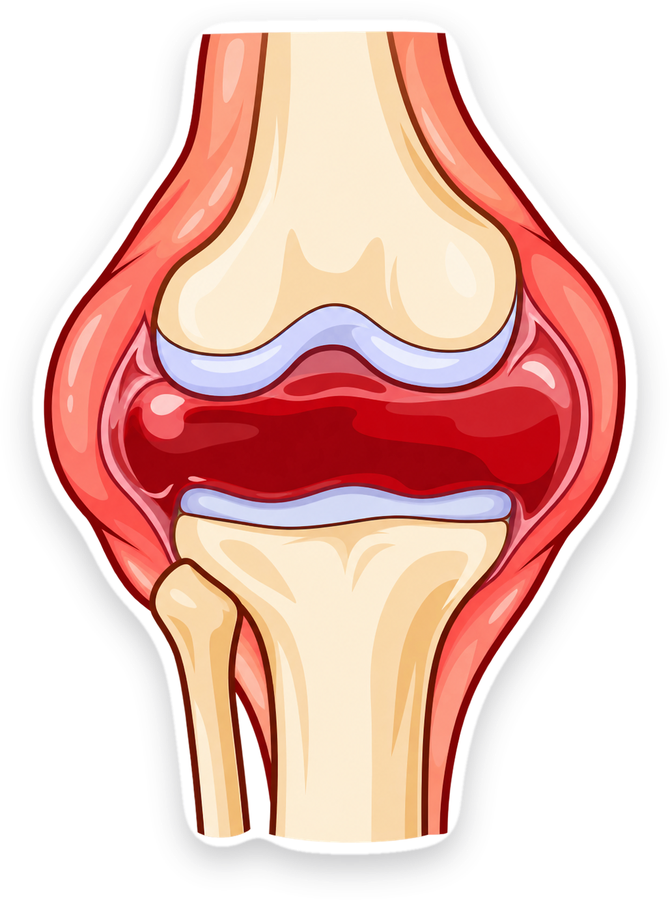
Bleeding into a joint makes it hot, tight and painful, most often the knee. Treat it with factor replacement, then rest and ice.
Treatment and Medication Safety?
3
Treatment and Medication Safety
⚠EXAM TRAPWatch outMedication trap: DDAVP is for mild hemophilia A only, not factor IX deficiency.
Replace the missing factor promptly when bleeding is suspected or before procedures.
DDAVP may help selected mild hemophilia A by increasing available factor VIII; it does not treat hemophilia B.
Avoid aspirin, NSAIDs, IM injections, and unnecessary arterial sticks.
Use acetaminophen for pain when appropriate and approved, and coordinate with the hemophilia treatment team.
Replace the missing factor promptly when a bleed is suspected, and use ice for the joint. Avoid aspirin, NSAIDs and IM injections.
Nursing Care and Teaching?
4
Nursing Care and Teaching
NCLEX tipNCLEX trap: hemophilia causes deep bleeding such as joints and muscles; petechiae point more toward platelet problems.
For hemarthrosis, use rest, ice, compression, elevation, and factor replacement as ordered.
Teach home factor infusion if prescribed and ensure emergency plans for trauma.
Encourage protective gear and low-impact activity; avoid high-contact sports.
Medical alert identification is essential.
Assess family coping, school plans, and genetic counseling needs.
Key nursing points
X-linked recessive
Hemophilia A
Hemophilia B (Christmas disease)
Hemarthrosis (bleeding into joints)
Treatment
Key nursing points
X-linked recessive: males affected, females are carriers.
Hemophilia A: factor VIII deficiency (most common, 80% of cases).
Hemophilia B (Christmas disease): factor IX deficiency.
Hemarthrosis (bleeding into joints): knees, elbows, ankles most common.
Treatment: factor replacement therapy (recombinant factor VIII or IX) or DDAVP for mild hemophilia A.
Avoid aspirin, NSAIDs, IM injections, contact sports.
⚠EXAM TRAPCommon exam trapHemophilia: aPTT is prolonged; PT is NORMAL. Contrast with vitamin K deficiency where BOTH PT and aPTT are prolonged. Do NOT give IM injections — use subcutaneous or IV routes.
Test yourself?
Test yourself
Pick your answer first, then open the rationale. Guessing teaches nothing.
Question 1 of 3
A nurse is assessing a 10-year-old boy with hemophilia A who reports pain and swelling in the right knee after a minor fall at school. Which action is the nurse's priority?
Answer: Apply RICE (rest, ice, compression, elevation) and notify the provider to arrange factor VIII replacement. Hemarthrosis (joint bleeding) in hemophilia A requires immediate factor VIII replacement to stop the bleeding and prevent permanent joint damage; RICE is applied for comfort while replacement therapy is arranged. Aspirin and NSAIDs are absolutely contraindicated in hemophilia because they further impair platelet function and worsen bleeding.
Question 2 of 3
A child with mild hemophilia A is scheduled for a dental extraction. The provider orders desmopressin (DDAVP) preoperatively. The parents ask why this is being given instead of factor VIII. What is the nurse's best explanation?
Answer: 'DDAVP stimulates the release of stored factor VIII from endothelial cells, raising factor levels temporarily in mild hemophilia A.' DDAVP (desmopressin) causes release of von Willebrand factor and stored factor VIII from endothelial cells, providing a temporary rise in factor VIII levels; it is effective only in mild hemophilia A (where some factor VIII is still produced) and is not useful in severe disease or hemophilia B. It is a cost-effective, plasma-free alternative that avoids the risks of blood product infusion.
Question 3 of 3
A teenager with severe hemophilia B reports a minor head injury after bumping into a locker at school. The patient feels fine and has no symptoms. What is the nurse's most appropriate action?
Answer: Treat this as a potential intracranial hemorrhage emergency: notify the provider and prepare for factor IX replacement and imaging. Even minor head trauma in a patient with severe hemophilia carries a significant risk of intracranial hemorrhage, which may not be immediately symptomatic; prompt factor IX replacement and neuroimaging are required regardless of the absence of current symptoms. Waiting for symptoms before treating is dangerous because ICH can progress rapidly to herniation.
In one line
Factor VIII (hemophilia A) or factor IX (hemophilia B) deficiency → prolonged bleeding.
— 8 —
Finish lesson
Save your completion
Sign in to record progress, sync completion, and keep your study streak accurate.