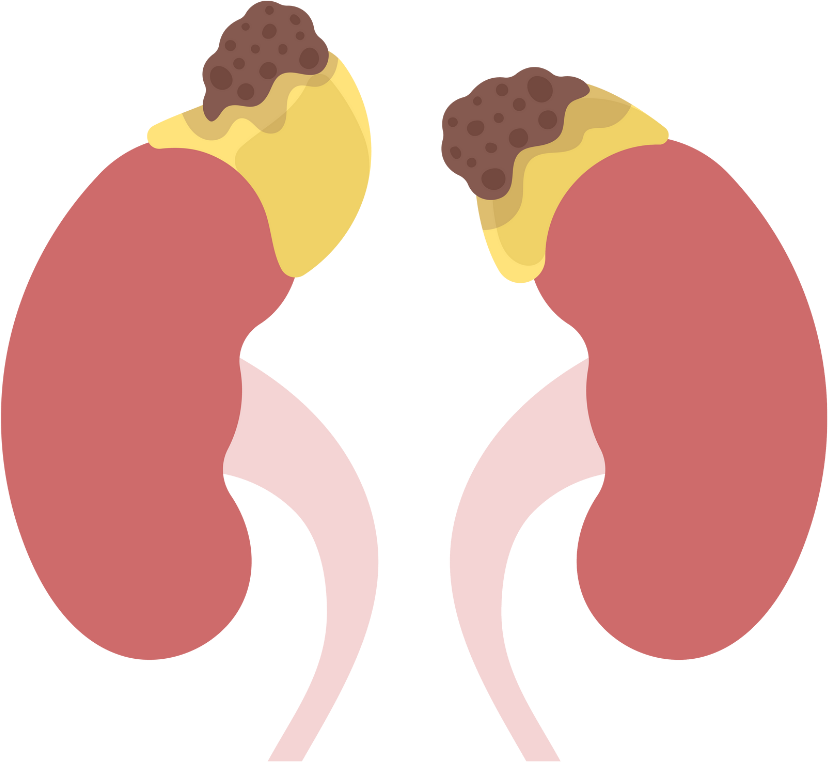
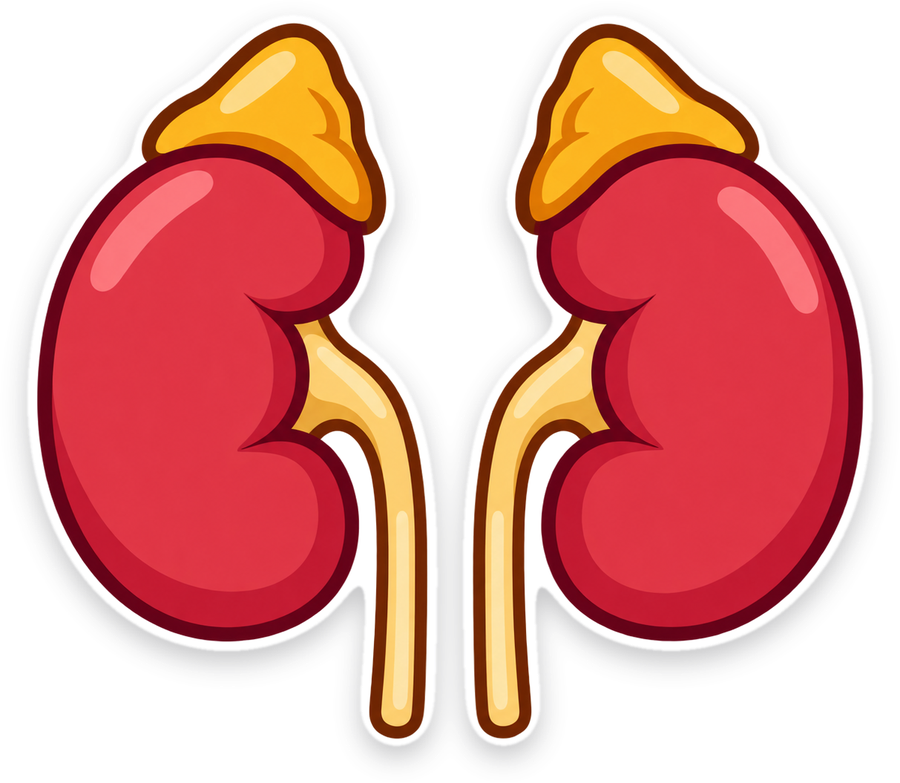
Cortex makes cortisol, aldosterone, and androgens; medulla makes epinephrine and norepinephrine.
What the Adrenals Control?
1
What the Adrenals Control
The adrenal cortex makes cortisol, aldosterone, and adrenal androgens; the adrenal medulla releases catecholamines such as epinephrine and norepinephrine.
The adrenals sit on top of the kidneys. The cortex makes cortisol and aldosterone; the medulla makes adrenaline and noradrenaline.
Addison Disease and Addisonian Crisis?
2
Addison Disease and Addisonian Crisis
NCLEX tipNCLEX trap: low BP plus hyperkalemia in an adrenal patient is Addisonian crisis until proven otherwise.
Addisonian crisis is a circulation emergency, not just an endocrine lab problem.
Assessment cues: weakness, weight loss, salt craving, GI upset, hyperpigmentation, orthostasis.
Labs often trend toward low sodium, high potassium, low glucose, and low cortisol.
Priority actions in crisis: rapid assessment, IV access, cardiac monitoring, isotonic fluids, glucocorticoid replacement as ordered, and treatment of the trigger.
Teaching: never stop chronic steroids abruptly; carry medical alert identification; follow sick-day steroid instructions.
High ACTH darkens the skin in Addison disease, most visibly in skin creases, scars and the gums. It is a clue, not the emergency.
Cushing Syndrome?
3
Cushing Syndrome
Cushing syndrome is chronic cortisol excess from exogenous steroids, pituitary ACTH excess, adrenal tumors, or ectopic ACTH.
If caused by steroid therapy, taper only as prescribed; abrupt withdrawal can cause adrenal crisis.
After adrenal or pituitary surgery, watch for acute cortisol deficit and fluid/electrolyte shifts.
Cortisol moves fat to the trunk and wastes the muscle in the arms and legs. A heavy middle on thin limbs is the Cushing shape.
Pheochromocytoma Priorities?
4
Pheochromocytoma Priorities
⚠EXAM TRAPWatch outNever give a beta blocker first in pheochromocytoma; unopposed alpha vasoconstriction can worsen hypertension.
Pheochromocytoma is usually an adrenal medulla tumor that releases catecholamines.
Classic spell: pounding headache, palpitations, diaphoresis, tremor, and severe episodic hypertension.
Avoid palpating the abdomen forcefully; tumor stimulation can provoke catecholamine release.
Medication safety: alpha blockade comes before beta blockade when preparing for surgery.
Post-op nursing: monitor BP closely, assess glucose, manage pain, and watch for adrenal insufficiency if bilateral disease is involved.
A pheochromocytoma floods the body with catecholamines and sends the pressure soaring. Give alpha blockade before any beta blocker.
Key nursing points
Addisonian crisis
Lifelong glucocorticoid +…
Pheochromocytoma surgery
Key nursing points
Addisonian crisis: hypotension, shock → IV hydrocortisone + fluids immediately.
Lifelong glucocorticoid + mineralocorticoid replacement for Addison's.
Pheochromocytoma surgery: alpha-block FIRST (phenoxybenzamine), then beta-block.
⚠EXAM TRAPCommon exam trapNever give a beta-blocker BEFORE an alpha-blocker in pheochromocytoma — blocking beta-vasodilation while leaving alpha-vasoconstriction unopposed triggers a severe hypertensive crisis. For Addisonian crisis: IV hydrocortisone + saline STAT — this is a shock emergency.
Test yourself?
Test yourself
Pick your answer first, then open the rationale. Guessing teaches nothing.
Question 1 of 5
A patient with known Addison's disease arrives at the emergency department following a 3-day episode of severe vomiting and diarrhea. Assessment findings include BP 74/40 mmHg, HR 122 bpm, Na⁺ 122 mEq/L, K⁺ 6.1 mEq/L, and blood glucose 48 mg/dL. What is the nurse's priority intervention?
Answer: Give IV hydrocortisone 100 mg bolus and begin aggressive isotonic fluid resuscitation. This is an Addisonian crisis (acute adrenal insufficiency precipitated by physiologic stress); immediate IV hydrocortisone (100–300 mg) and aggressive IV normal saline with dextrose address the vascular collapse, hyponatremia, hypoglycemia, and lack of cortisol simultaneously. Oral medications are not effective in a patient with vomiting and hemodynamic collapse.
Question 2 of 5
A patient is diagnosed with a pheochromocytoma and is scheduled for surgical removal. Which medication does the nurse expect to be administered before surgery, and why?
Answer: An alpha-blocker first to block vasoconstriction, then a beta-blocker if needed Alpha blockade (e.g., phenoxybenzamine) must precede beta blockade in pheochromocytoma; giving a beta-blocker first leaves alpha-mediated vasoconstriction unopposed and can cause a dangerous, potentially fatal hypertensive crisis. Alpha blockade first prevents catecholamine-induced vasoconstriction; beta blockers are then added if tachycardia persists.
Question 3 of 5
The nurse is teaching a patient newly diagnosed with Addison's disease about sick-day management. Which statement by the patient indicates correct understanding?
Answer: 'If I develop vomiting or fever, I should double or triple my steroid dose and seek care.' Patients with Addison's disease cannot mount a cortisol stress response; during illness, surgery, or trauma, they must increase (not decrease) their glucocorticoid dose per sick-day rules to prevent adrenal crisis. Reducing or omitting steroids during physiologic stress can lead to life-threatening hemodynamic collapse.
Question 4 of 5
A patient with primary adrenal insufficiency asks why they take two different medications: hydrocortisone and fludrocortisone. Which explanation is MOST accurate?
Answer: 'Hydrocortisone replaces glucocorticoids (cortisol) for metabolism and stress response; fludrocortisone replaces mineralocorticoids (aldosterone) for sodium retention and potassium excretion.' Primary adrenal insufficiency (Addison's disease) involves destruction of the adrenal cortex, causing deficiency of both glucocorticoids and mineralocorticoids; hydrocortisone replaces cortisol for metabolic regulation and stress response, while fludrocortisone replaces aldosterone to maintain sodium-potassium balance and blood pressure. Both are required in primary adrenal insufficiency, while secondary insufficiency (pituitary-related) typically requires only glucocorticoid replacement.
Question 5 of 5
A patient with Addison's disease develops hyperkalemia of 6.2 mEq/L and hyponatremia of 128 mEq/L on laboratory review. Which medication deficiency BEST explains this electrolyte pattern?
Answer: Insufficient mineralocorticoid (fludrocortisone) — aldosterone deficiency causes sodium loss and potassium retention. Aldosterone (mineralocorticoid) acts on the renal collecting tubule to reabsorb sodium and excrete potassium; deficiency in Addison's disease leads to the classic pattern of hyponatremia and hyperkalemia. Fludrocortisone replacement normalizes this electrolyte pattern and prevents the associated volume depletion and hypotension.
In one line
Addison's (too little) vs Cushing's (too much) vs Pheochromocytoma.
— 5 —
Finish lesson
Save your completion
Sign in to record progress, sync completion, and keep your study streak accurate.