SIADH vs Diabetes Insipidus
Two opposite ADH problems — opposite urine, opposite sodium.
- Lesson 2 of 7
- 6 min read
Side by side
SIADH vs Diabetes Insipidus
SIADH = Soaked Inside (too much ADH → water retention). DI = Dry Inside (too little ADH → water loss).
- Excess ADH secretion
- Kidneys retain free water
- Insufficient ADH (central) or renal resistance (nephrogenic)
- Kidneys cannot concentrate urine
- Low — dilutional hyponatremia
- Moderate: Na⁺ 120–129 mEq/L
- Severe: Na⁺ < 120 mEq/L → seizure risk
- High — hypernatremia
- Na⁺ > 145 mEq/L
- Low < 280 mOsm/kg
- Blood is dilute
- High > 295 mOsm/kg
- Blood is concentrated
- Decreased — oliguria
- Urine concentrated (high osmolality > 100)
- Dramatically increased — polyuria > 3 L/24 hr
- Urine dilute (low osmolality < 200, SG < 1.005)
Overview
SIADH (Syndrome of Inappropriate ADH): excess ADH → water retention → dilute serum, concentrated urine, hyponatremia.
SIADH — Syndrome of Inappropriate ADH
SIADH is a water problem that shows up as a sodium problem.
- Mechanism: excess ADH → renal water retention despite normal or low serum osmolality → dilutional hyponatremia + concentrated urine.
- Causes: brain tumors/injury/meningitis, lung cancer (especially small-cell), pneumonia, drugs (SSRIs, carbamazepine, cyclophosphamide, NSAIDs).
- Lab pattern: LOW serum Na+ (<135), LOW serum osmolality, HIGH urine sodium (>40), HIGH urine specific gravity (>1.012).
- Symptoms: headache, confusion, nausea, seizures (all from hyponatremia/cerebral edema).
- Treatment: FLUID RESTRICTION is first-line. Hypertonic saline (3%) for severe symptoms. Demeclocycline (blocks ADH at kidney) for chronic SIADH.
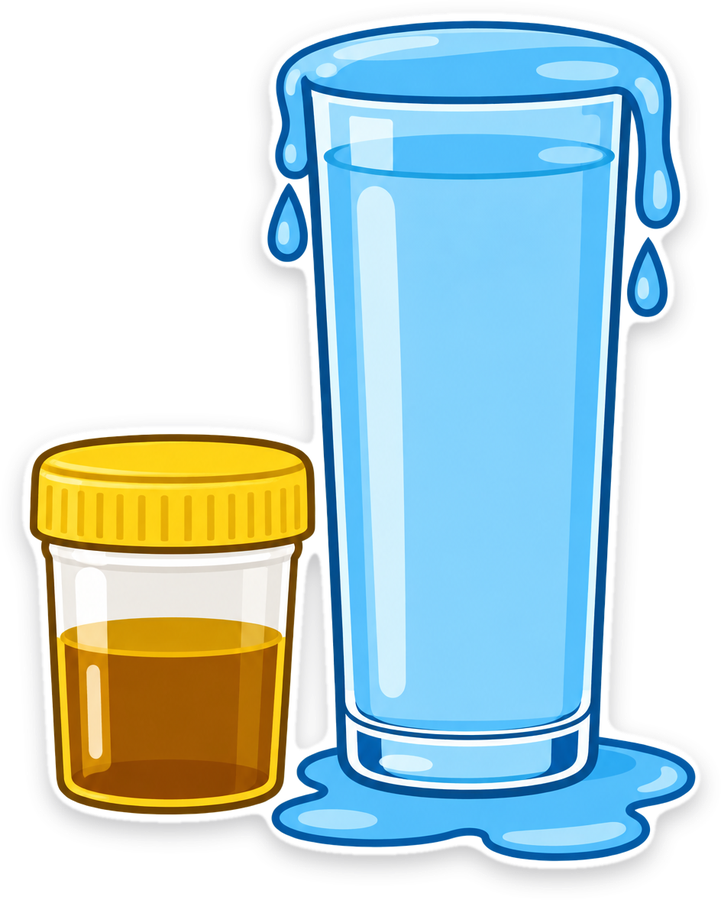
Diabetes Insipidus (DI)
Diabetes insipidus is free-water loss.
- Mechanism: insufficient ADH (central DI) or kidneys don't respond to ADH (nephrogenic DI) → massive dilute urine output (3–20 L/day) → free water deficit → hypernatremia.
- Central causes: head trauma, neurosurgery, brain tumor, meningitis, pituitary damage.
- Nephrogenic causes: lithium toxicity, hypercalcemia, inherited.
- Lab pattern: HIGH serum Na+ (>145), HIGH serum osmolality, LOW urine sodium, LOW urine specific gravity (<1.005), LOW urine osmolality.
- Symptoms: intense polydipsia, polyuria, dehydration, weakness, altered mental status.
- Treatment: Central DI → desmopressin (DDAVP). Nephrogenic DI → low-sodium diet + thiazides (paradoxically reduce urine output). Both: free water replacement.
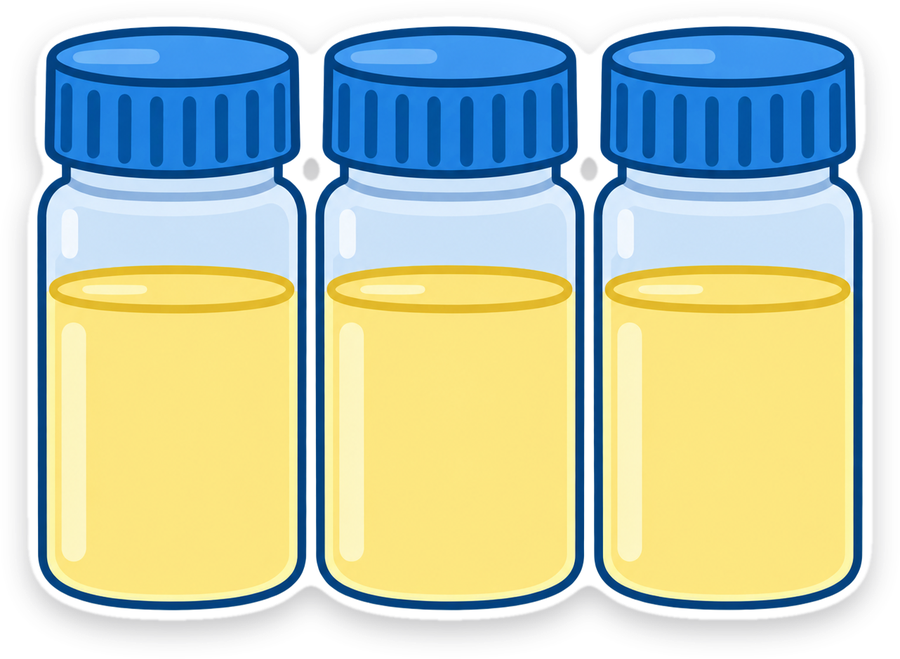
Comparison Table
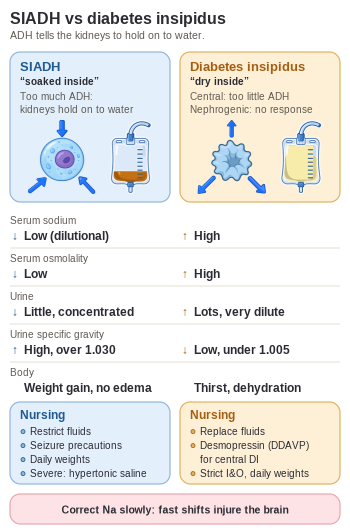
The fastest way to separate the two disorders is to ask where the water is.
- SIADH: ↓ serum Na, ↓ serum Osm, ↑ urine Na, ↑ urine SG, ↓ urine output → fluid restrict.
- DI: ↑ serum Na, ↑ serum Osm, ↓ urine Na, ↓ urine SG, ↑↑ urine output → replace free water / DDAVP.
- Daily weights and strict I&O are essential for both. Neuro checks critical.
Understanding ADH
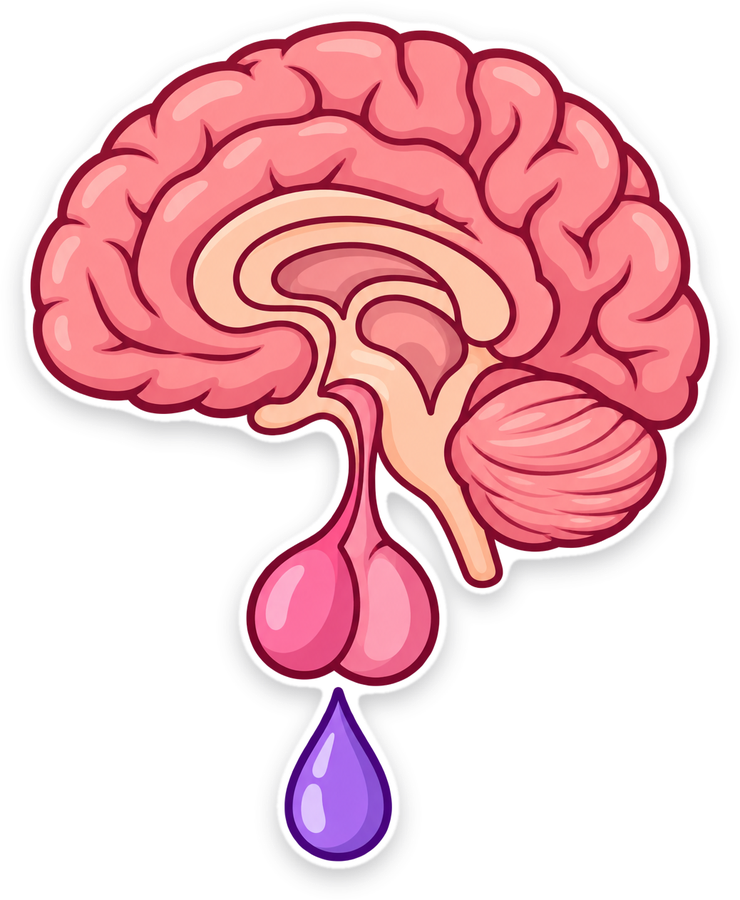
Antidiuretic hormone (ADH), also called vasopressin, is released from the posterior pituitary when serum osmolality rises or circulating volume falls.
SIADH is ADH excess despite low serum osmolality.
Sodium Correction Safety
The danger is not only the sodium value; it is the speed of change.
During active correction, trend serum sodium frequently, monitor level of consciousness and seizure activity, and compare current correction rate to the 24-hour maximum.
SIADH vs Diabetes Insipidus
| SIADH — Soaked Inside | DI — Dry Inside | |
|---|---|---|
| ADH level | Excess ADH secretion • Kidneys retain free water | Insufficient ADH (central) or renal resistance (nephrogenic) • Kidneys cannot concentrate urine |
| Serum sodium | Low — dilutional hyponatremia • Moderate: Na⁺ 120–129 mEq/L • Severe: Na⁺ < 120 mEq/L → seizure risk | High — hypernatremia • Na⁺ > 145 mEq/L |
| Serum osmolality | Low < 280 mOsm/kg • Blood is dilute | High > 295 mOsm/kg • Blood is concentrated |
| Urine output | Decreased — oliguria • Urine concentrated (high osmolality > 100) | Dramatically increased — polyuria > 3 L/24 hr • Urine dilute (low osmolality < 200, SG < 1.005) |
| Clinical signs | Weight gain without edema • Confusion, headache, nausea • Seizures if Na⁺ < 120 mEq/L • Decreased deep tendon reflexes | Intense thirst (polydipsia) • Dehydration signs — tachycardia, hypotension • Dry mucous membranes • Sunken eyes, poor skin turgor |
| Treatment | Fluid restriction 500–1500 mL/day • 3% NaCl if Na⁺ < 120 or seizures present • Loop diuretics (furosemide) • Treat underlying cause (malignancy, medications, CNS) | Central DI: DDAVP (desmopressin) intranasal or IV • Nephrogenic DI: thiazide diuretics + low-sodium diet • IV hypotonic fluids (D5W or 0.45% NS) for dehydration • Correct underlying cause |
| Monitoring priority | Serum sodium q4–6h if actively correcting • Neuro checks — watch for confusion and seizures • Daily weight + strict I&O | Hourly urine output (> 200 mL/hr = alarm) • Urine specific gravity q shift • Serum sodium and osmolality q4–6h |
Nursing priorities
- 1. Track hourly urine output in the acute phase. — DI urine output greater than 200 mL/hr is an alarm threshold for rapid free-water loss and worsening hypernatremia.
- 2. Check serum sodium every 2-4 hr during active correction. — Correction faster than 8-10 mEq/L per 24 hr for hyponatremia, or 10-12 mEq/L per 24 hr for hypernatremia, can cause major neurologic injury.
- 3. Obtain daily weights with strict intake and output. — A 1 kg weight change is approximately 1 L of fluid shift, making weight a sensitive marker of water retention or loss.
Key nursing points
- SIADH → ↓Na, ↓UO, ↑urine SG. Treat: fluid restrict, hypertonic saline, demeclocycline.
- DI → ↑Na, huge UO (>3 L/day), dilute urine. Treat: desmopressin (DDAVP), free water.
- Daily weights, strict I&O, neuro checks for both.
Test yourself

Pick your answer first, then open the rationale. Guessing teaches nothing.
Two opposite ADH problems — opposite urine, opposite sodium.
— 2 —