Burns & Rule of 9s
Depth, %TBSA, Parkland formula, airway first in inhalation injury.
- Lesson 2 of 8
- 7 min read
Mnemonic · Rule of Nines Memory Hook
Rule of Nines Memory Hook
- 9Head
- 9+9Each arm
- 18Chest
- 18Back
- 18+18Each leg
- 1Perineum
Overview
The critical care source describes burns as superficial/first-degree, partial-thickness/second-degree, full-thickness/third-degree, and deeper injury into muscle or bone.
Rule of Nines for Fluid Calculation
Parkland Formula: 4 mL x weight (kg) x %TBSA burned = total Lactated Ringer's in the first 24 hrs.
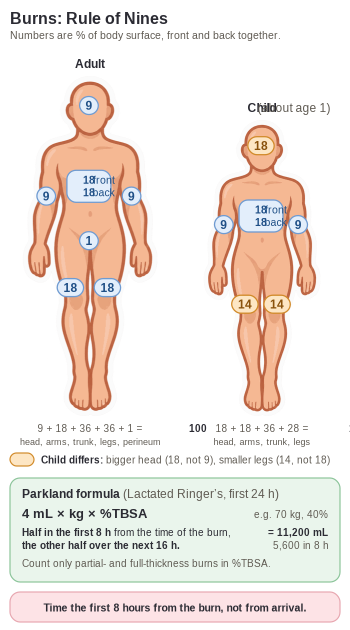
Rule of Nines Memory Hook
The Rule of Nines is a rapid adult estimate used in the first minutes of burn care.
Burn Depth Classification
Burn depth predicts pain, fluid loss, infection risk, and whether grafting may be needed.
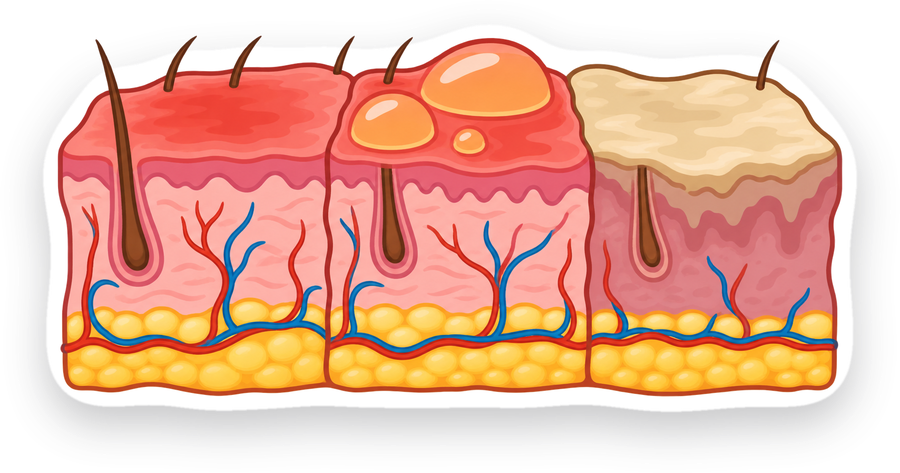
| Depth | Appearance | Sensation | Healing |
|---|---|---|---|
| Superficial / 1st degree | Red, dry, blanches; no blisters | Painful and tender | Heals in 3-5 days without grafting |
| Partial thickness / 2nd superficial | Blistered, moist, pink or red | Very painful | Heals in 14-21 days; scarring risk varies |
| Partial thickness / 2nd deep | Red/white mottled, less moist | Less painful because deeper nerves are injured | Heals > 21 days; grafting may be needed |
| Full thickness / 3rd degree | White, brown, black, waxy, or leathery | Painless in center from nerve destruction | Grafting required; high contracture and infection risk |
Inhalation Injury
Do not rely on pulse oximetry to rule out carbon monoxide poisoning; obtain carboxyhemoglobin when smoke exposure is suspected.

Curling's Ulcer + Wound Care
Wound care must also balance infection control, pain control, warmth, and preservation of viable tissue.
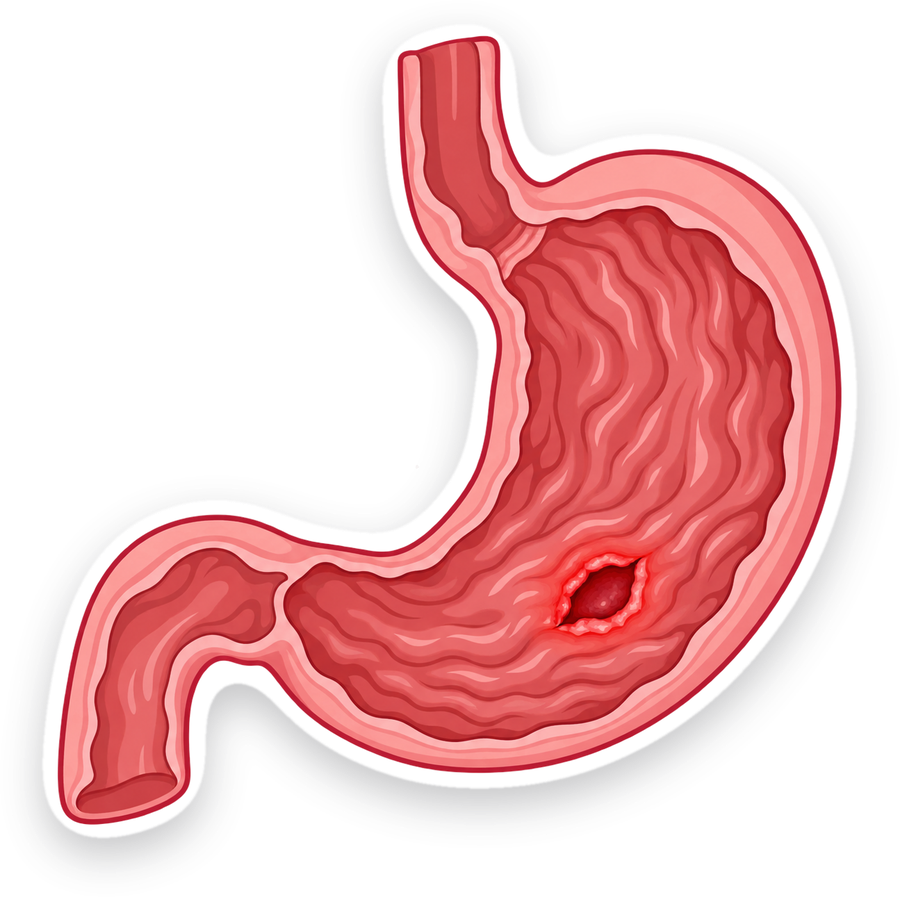
- Stress ulcer prophylaxis with a PPI or H2 blocker is expected in major burns, especially burns > 35% TBSA, because Curling's ulcers can bleed.
- Silver sulfadiazine is commonly used; apply with a gloved hand, avoid mucous membranes, and monitor CBC because it can cause neutropenia.
- Mafenide acetate penetrates eschar well but is painful during application; give analgesia before wound care.
- Bacitracin is often used for facial and superficial burns where silver sulfadiazine is not ideal.
- Wound care requires analgesia, warmth, clean or sterile technique per unit policy, tetanus review, and infection surveillance.
Nursing priorities
- 1. Titrate fluid resuscitation to urine output. — Goal urine output is 0.5-1 mL/kg/hr in adults and about 1 mL/kg/hr in children; falling output suggests under-resuscitation or shock.
- 2. Assess circumferential burns for neurovascular compromise. — Loss of pulses, worsening pain, paresthesia, pallor, paralysis, or compartment syndrome signs may require escharotomy.
- 3. Elevate burned extremities above heart level. — Elevation reduces edema and helps preserve distal perfusion during the capillary leak phase.
Key nursing points
- Rule of 9s adult: head 9%, each arm 9%, chest/anterior trunk 18%, back/posterior trunk 18%, each leg 18%, perineum 1%.
- Parkland: 4 mL x weight (kg) x %TBSA burned = total LR in first 24 hrs; give half in first 8 hrs from burn time, not arrival time.
- Airway first in facial or inhalation burns — intubate early for hoarseness, stridor, carbonaceous sputum, or progressive edema.
- Full-thickness burns may be painless because nerves are destroyed; absence of pain is not reassuring.
Test yourself

Pick your answer first, then open the rationale. Guessing teaches nothing.
Depth, %TBSA, Parkland formula, airway first in inhalation injury.
— 2 —