Sepsis: Recognition & Bundles
Life-threatening organ dysfunction from dysregulated infection response.
- Lesson 1 of 8
- 8 min read
Mnemonic · TIME
TIME
- TTreatment
- IIs
- MMost
- EEffective
Overview
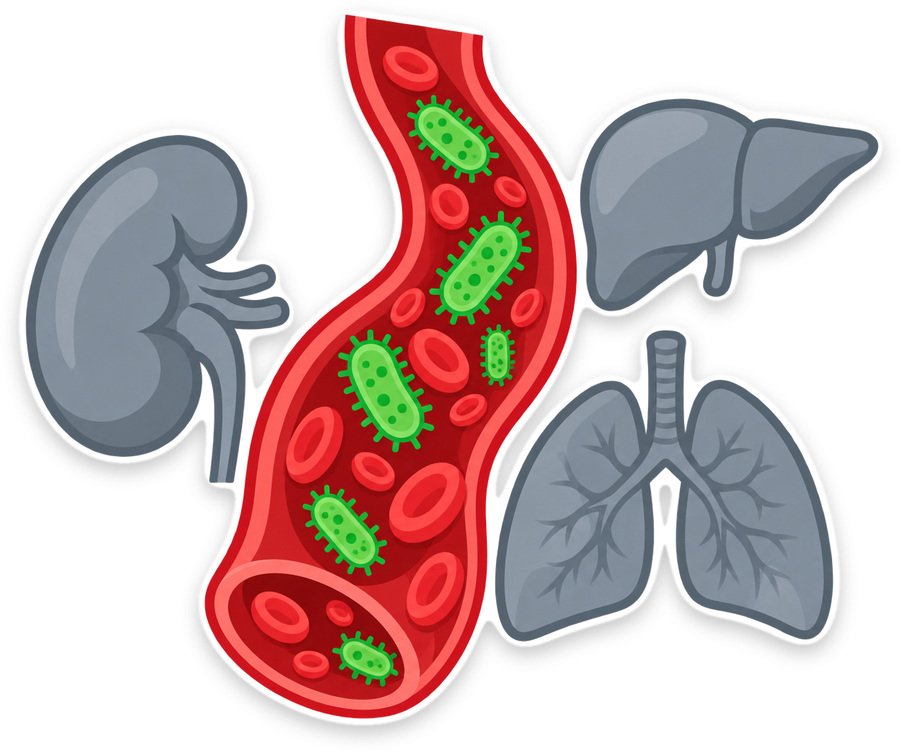
Sepsis is a time-critical progression from infection to organ dysfunction, shock, and multi-organ failure.
Sepsis-3 Definition Update
Sepsis = life-threatening organ dysfunction caused by a dysregulated host response to infection.
It is defined as sepsis with vasopressors needed to maintain MAP >= 65 mmHg plus serum lactate > 2 mmol/L despite adequate fluid resuscitation.
Hour-1 Bundle
The bundle is designed to happen in parallel.
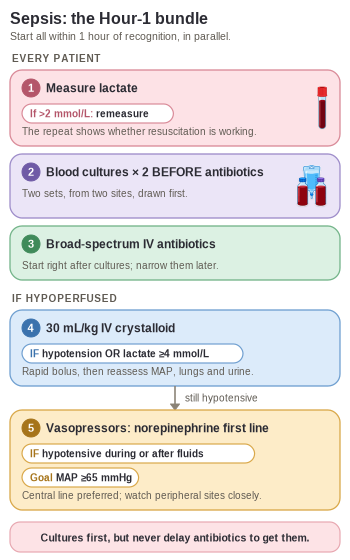
Sepsis Hour-1 Bundle Memory
A memory hook is useful only if it speeds action at the bedside.

Lactate Interpretation
Lactate is a marker of tissue hypoperfusion and impaired oxygen use.

| Lactate | Interpretation | Action |
|---|---|---|
| < 2 mmol/L | Normal or no current lactate elevation | Continue assessment, monitor for trend changes, and treat the infection source. |
| 2-4 mmol/L | Tissue hypoperfusion; early warning of worsening sepsis | Treat aggressively, repeat lactate, reassess perfusion, and escalate if not improving. |
| > 4 mmol/L | High mortality risk and severe hypoperfusion | Escalate care immediately, begin/continue resuscitation, and repeat in 2 hrs after resuscitation. |
SIRS → Sepsis → Septic Shock Continuum
| Sepsis (Sepsis-3 Definition) | Septic Shock | |
|---|---|---|
| Definition | Life-threatening organ dysfunction caused by dysregulated host response to infection • SOFA score ≥ 2 from baseline | Sepsis + vasopressors required to maintain MAP ≥ 65 mmHg • AND lactate > 2 mmol/L despite adequate fluid resuscitation |
| Vital signs | Fever > 38.3°C or hypothermia < 36°C • HR > 90, RR > 20 or PaCO2 < 32 • Altered mental status | Persistent hypotension (SBP < 90 or MAP < 65) despite 30 mL/kg IV fluid • Cool, clammy skin — late warm/flushed in distributive phase |
| Lactate | Lactate 2–4 mmol/L = tissue hypoperfusion • Repeat in 2 hr after resuscitation | Lactate > 4 mmol/L = high mortality • Lactate not clearing = escalate immediately |
| Hour-1 bundle | 1. Measure lactate (repeat if > 2) • 2. Blood cultures × 2 BEFORE antibiotics • 3. Broad-spectrum IV antibiotics within 1 hr • 4. 30 mL/kg IV crystalloid if hypotensive | 5. Vasopressors (norepinephrine first-line) if MAP < 65 despite fluids • Target MAP ≥ 65 mmHg • Central line preferred for vasopressors • ICU-level monitoring |
| Mortality | ~10% with timely treatment • Rises sharply each hour without antibiotics | ~40% even with optimal care • Source control critical (drain abscess, remove infected line) |
Nursing priorities
- 1. Do NOT delay antibiotics waiting for cultures. — Draw blood cultures first when this can be done immediately, then give antibiotics; treatment delay increases mortality.
- 2. If vasopressors are required, anticipate norepinephrine and central-line administration. — Norepinephrine is first-line for septic shock. A central line is preferred; if peripheral infusion is used, monitor the site closely for extravasation.
- 3. Trend lactate clearance and escalate if lactate is not improving. — Target lactate clearance is > 10% reduction per hour; failure to clear suggests ongoing hypoperfusion or inadequate source control.
Key nursing points
- Sepsis-3: life-threatening organ dysfunction from a dysregulated host response to infection; SOFA score increase >= 2 indicates organ dysfunction.
- Septic shock: sepsis plus vasopressors required to maintain MAP >= 65 and lactate > 2 mmol/L despite adequate fluids.
- Hour-1 bundle: lactate, cultures before antibiotics, broad-spectrum IV antibiotics, 30 mL/kg crystalloid when indicated, then vasopressors if MAP remains < 65.
- Source control remains essential: drain abscess, debride infected tissue, remove infected line, or obtain surgical consult.
Test yourself

Pick your answer first, then open the rationale. Guessing teaches nothing.
Life-threatening organ dysfunction from dysregulated infection response.
— 1 —