Progressive cortical dementia — amyloid plaques + tau tangles.
Lesson 4 of 11
6 min read
Overview?
Overview
Most common form of dementia.
Progressive cortical dementia — amyloid plaques + tau tangles.
Pathophysiology?
1
Pathophysiology
Acetylcholine levels fall as neurons degenerate, impairing memory and cognition.
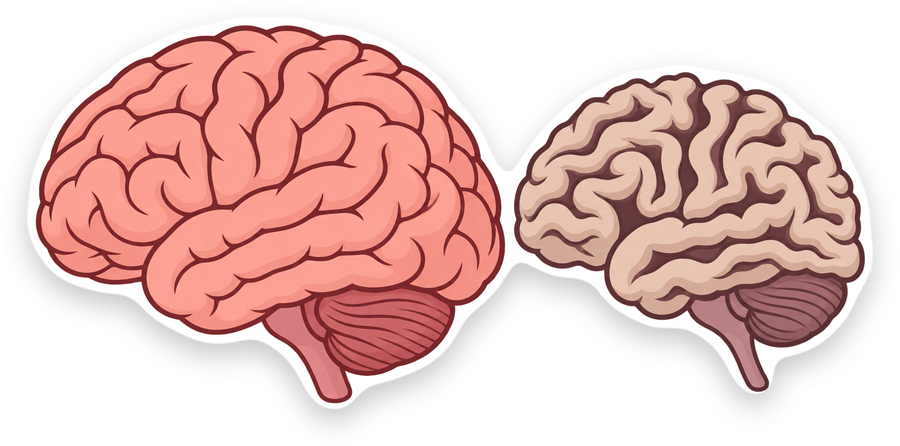
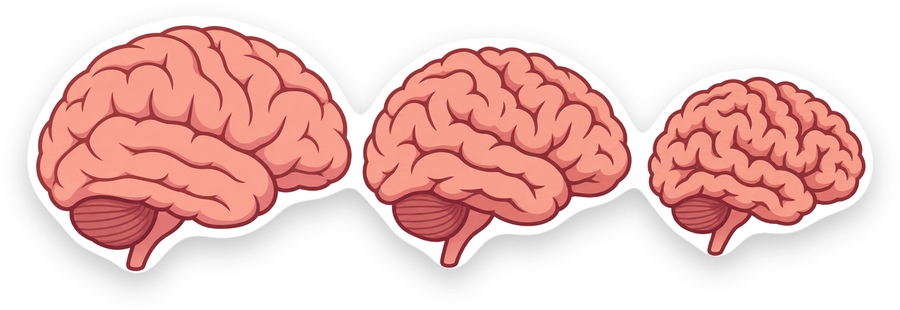
Alzheimer's shrinks the brain: grooves widen and tissue is lost, starting in the memory centre. The damage cannot be reversed.
Stages of Decline?
2
Stages of Decline
A sudden mental-status change is not expected Alzheimer's progression; assess for delirium causes such as infection, dehydration, medication effects, hypoxia, or pain.
Early: short-term memory loss, word-finding difficulty, repetitive questioning, misplacing items, getting lost in familiar places.
Safety: remove rugs, install grab bars, lock medications and chemicals.
Validate feelings, redirect rather than argue.
⚠EXAM TRAPCommon exam trapDonepezil and memantine slow Alzheimer's progression — they do NOT cure it. Do NOT use anticholinergic drugs in Alzheimer's patients (they worsen cognition by blocking acetylcholine). Acute sudden confusion is delirium (reversible), not Alzheimer's — always look for a treatable cause.
Test yourself?
Test yourself
Pick your answer first, then open the rationale. Guessing teaches nothing.
Question 1 of 5
A patient with moderate-stage Alzheimer's disease becomes increasingly agitated and confused every evening. Which nursing intervention is MOST appropriate?
Answer: Maintain consistent evening routines and keep the room well-lit. Sundowning — worsening confusion and agitation in the late afternoon and evening — is managed through consistency, good lighting, and calming familiar routines, which reduce disorientation. Sedatives (option A) carry risks of falls and paradoxical agitation in dementia patients and are not first-line.
Question 2 of 5
The nurse is reviewing medication orders for a patient with moderate-to-severe Alzheimer's disease. Which medication is indicated for this stage of the disease?
Answer: Memantine (Namenda) — an NMDA receptor antagonist. Memantine is approved for moderate-to-severe Alzheimer's disease, where it modulates glutamate activity to slow symptom progression. Donepezil (option A) is used for mild-to-moderate disease; benzodiazepines and first-generation antipsychotics (options C and D) are generally avoided in dementia due to increased fall risk and mortality.
Question 3 of 5
A patient with late-stage Alzheimer's disease is admitted for aspiration pneumonia. Which nursing diagnosis is the HIGHEST priority?
Answer: Risk for aspiration related to impaired swallowing and cognitive loss. In late-stage Alzheimer's disease, loss of swallowing coordination and inability to protect the airway makes aspiration the most life-threatening physiologic risk; it has already caused the current admission. Psychosocial diagnoses (options A and C) and chronic confusion (option D) are valid but are lower priority than a physiologic safety threat.
Question 4 of 5
A nurse is caring for a client with advanced dementia who frequently attempts to get out of bed unassisted at night. Which safety intervention should the nurse implement first?
Answer: Lower the bed to the lowest position, place a fall mat, and use a bed exit alarm. The least-restrictive safety approach for a client at fall and wandering risk includes bed height reduction, fall mats, and exit alarms before considering physical or chemical restraints. Restraints and sedatives in dementia increase delirium, injury, aspiration, and mortality.
Question 5 of 5
A nurse is meeting with the adult daughter of a client with moderate Alzheimer's disease who is the primary caregiver. The daughter states, 'I feel guilty, but sometimes I just hate coming here.' Which assessment is the nurse's priority?
Answer: Assess the daughter for caregiver burden, burnout, and available support systems. Feelings of ambivalence and resentment are common indicators of caregiver burden in dementia caregiving; the priority is a compassionate assessment of burnout, respite availability, and support needs. Normalizing the feelings while connecting the caregiver to resources protects both the caregiver and the client.
In one line
Progressive cortical dementia — amyloid plaques + tau tangles.
— 4 —
Finish lesson
Save your completion
Sign in to record progress, sync completion, and keep your study streak accurate.