Seizures & Epilepsy
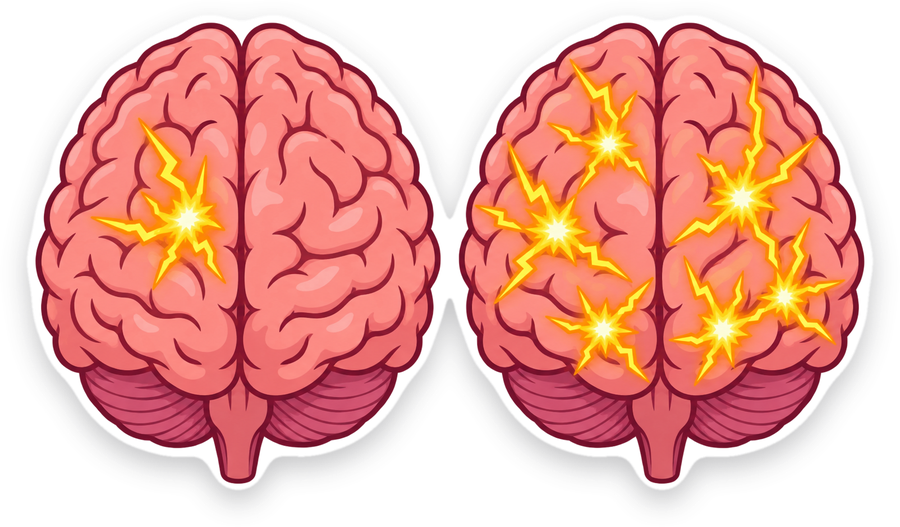
Abnormal electrical brain activity — focal vs generalized, tonic-clonic vs absence.
- Lesson 8 of 11
- 7 min read
3 nursing priorities
- 1Time every seizure from onset to cessation.Duration determines emergency escalation and status epilepticus treatment thresholds; document type, motor pattern, and post-ictal state.
- 2Start seizure precautions on admission for known epilepsy patients.Prepared oxygen, suction, padded rails, low bed, and environmental safety reduce preventable injury and aspiration risk.
- 3Monitor anti-epileptic drug levels when ordered, especially phenytoin 10-20 mcg/mL.Levels help prevent breakthrough seizures and toxicity before and after dose changes.
Overview
A seizure is a sudden, uncontrolled electrical disturbance in the brain.
Types of Seizures
Classify seizures by where they begin and whether awareness is preserved.
Clear documentation helps neurology correlate the event with EEG and medication response.
- Focal onset: originate in one brain region. May spread to become bilateral tonic-clonic (secondary generalization).
- Generalized tonic-clonic: aura → cry → tonic stiffening → clonic jerking → postictal confusion.
- Absence: brief LOC with blinking; no postictal phase; common in children.
- Myoclonic: sudden muscle jerks; brief; may cluster in morning.
- Atonic (drop attacks): sudden loss of muscle tone — fall risk.
- Febrile seizures: children 6 months–5 years; typically brief; usually benign.
| Type | Consciousness | Motor involvement | Duration |
|---|---|---|---|
| Focal aware | Awareness intact | May have localized twitching, sensory, autonomic, or psychic symptoms | Seconds to less than 2 min |
| Focal impaired awareness | Awareness impaired; may not remember event | Automatisms, staring, lip smacking, or nonpurposeful movement | Usually 1-2 min |
| Generalized tonic-clonic | Loss of consciousness | Tonic stiffening followed by clonic rhythmic jerking | Usually 1-3 min |
| Absence | Brief impaired awareness | Staring, eyelid flutter, minimal motor activity | Usually 5-30 sec |
| Myoclonic | Usually preserved or briefly altered | Sudden brief muscle jerks; may cluster | Seconds |
| Atonic | Brief impaired awareness possible | Sudden loss of tone/drop attack | Usually less than 15 sec |
Nursing Care During Seizure
Seizure precautions should be in place for patients with known epilepsy or acute neurologic risk: padded side rails, oxygen and suction available, IV access when ordered, bed in the lowest position, and sharp objects removed from the environment.
Do not restrain the patient and do not put anything in the mouth.
- Stay with patient; note start time, type, body parts involved.
- Turn patient to SIDE (lateral) to prevent aspiration of secretions.
- Protect head; remove harmful objects; loosen tight clothing.
- Do NOT restrain — may cause fractures. Do NOT insert anything in mouth.
- After: assess LOC, breathing, neuro status; document duration and characteristics.
- Give O2 if SpO2 drops; prepare IV benzodiazepine for prolonged seizure.

Status Epilepticus
Treat ongoing seizure activity as an airway, oxygenation, and brain-injury emergency.
Nursing priorities are timing, rapid escalation, oxygen/suction readiness, IV access, glucose check, medication preparation, and continuous reassessment.

Post-ictal Phase
Todd's paralysis is focal motor weakness after a seizure that typically resolves within 24 hours, but it can mimic stroke and should be documented carefully.
Do not leave the patient alone during the confused recovery period.

Medications
Valproate has the highest teratogenic risk and requires documented counseling; lamotrigine and levetiracetam have lower but non-zero risk.
Phenytoin has a narrow therapeutic index and nonlinear pharmacokinetics, meaning small dose changes can produce disproportionate level swings.
- Acute: lorazepam IV (first line), diazepam rectal, midazolam IM/intranasal.
- Status epilepticus: IV levetiracetam, fosphenytoin, phenobarbital after benzo failure.
- Chronic AEDs: levetiracetam (Keppra), valproate, lamotrigine, carbamazepine, phenytoin.
- Phenytoin: therapeutic level 10–20 mcg/mL; monitor for gingival hyperplasia, ataxia, nystagmus.
- Valproate: contraindicated in pregnancy (neural tube defects). Folic acid mandatory.

Nursing priorities
- 1. Time every seizure from onset to cessation. — Duration determines emergency escalation and status epilepticus treatment thresholds; document type, motor pattern, and post-ictal state.
- 2. Start seizure precautions on admission for known epilepsy patients. — Prepared oxygen, suction, padded rails, low bed, and environmental safety reduce preventable injury and aspiration risk.
- 3. Monitor anti-epileptic drug levels when ordered, especially phenytoin 10-20 mcg/mL. — Levels help prevent breakthrough seizures and toxicity before and after dose changes.
Key nursing points
- Focal aware seizure: conscious during event. Focal impaired-awareness: altered consciousness.
- Generalized tonic-clonic (grand mal): stiffening then rhythmic jerking, loss of consciousness.
- Absence seizure (petit mal): 5–30 sec blank stare, eyelid flutter — easy to miss.
- Status epilepticus: continuous seizure > 5 min OR 2 seizures without recovery — EMERGENCY.
- First-line drugs: levetiracetam, valproate, lamotrigine, phenytoin.
- NEVER put anything in patient's mouth during seizure — protect airway by positioning.
Test yourself

Pick your answer first, then open the rationale. Guessing teaches nothing.
Abnormal electrical brain activity — focal vs generalized, tonic-clonic vs absence.
— 8 —