ADPIE Nursing Process
The five-phase framework that defines safe, patient-centered nursing care.
- Lesson 1 of 15
- 8 min read
5 steps
- AAssessment
- DDiagnosis
- PPlanning
- IImplementation
- EEvaluation
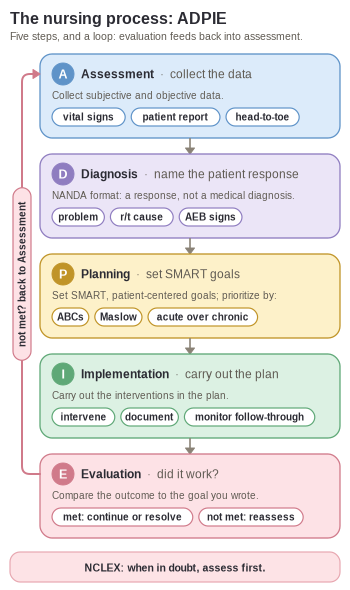
- A Collect subjective + objective data: interview, vitals, head-to-toe, chart review.
- D Identify nursing diagnoses — patient responses and risks, NOT medical disease names.
- P Set measurable, patient-centered short- and long-term goals with the patient and team.
- I Carry out interventions, document, and monitor patient follow-through.
- E Measure outcomes against the goal and revise the plan if outcomes were not met.
Overview
ADPIE (Assessment, Diagnosis, Planning, Implementation, Evaluation) is the standard-of-care nursing process.
Why ADPIE matters
Healthcare is a science.
Following ADPIE keeps decisions tied to patient data rather than assumption, makes care reproducible across shifts, and gives the interdisciplinary team a shared picture of the patient.
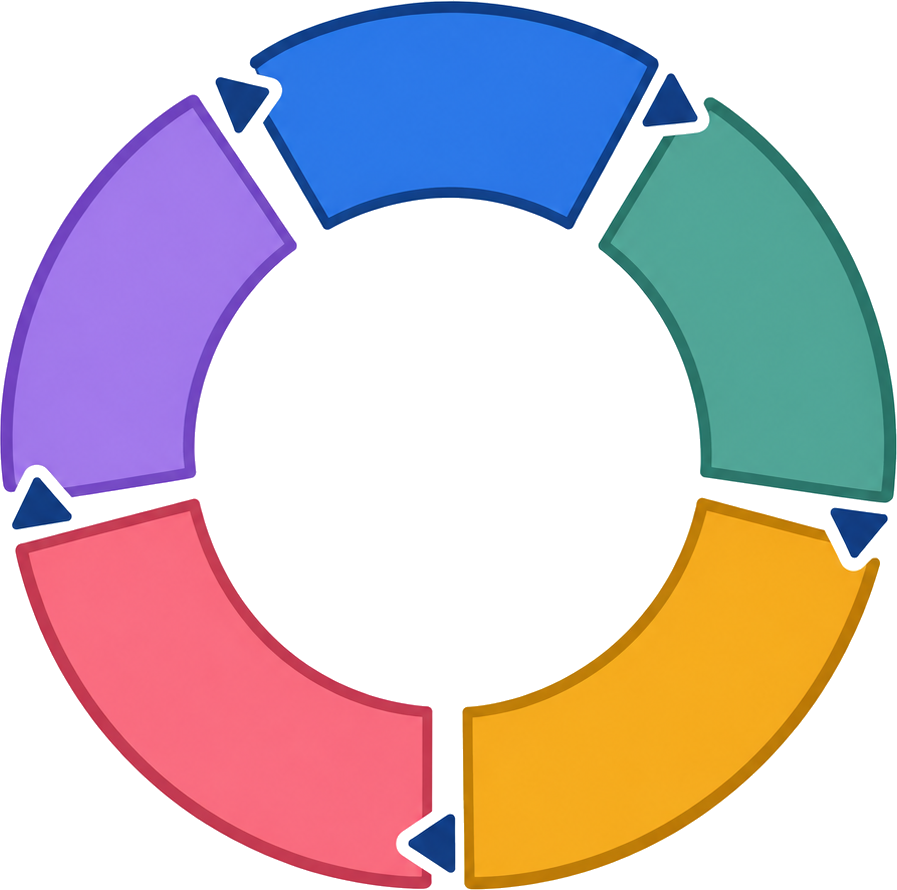 ADPIE
Assessment — collect the data
When you first encounter a patient, you are expected to perform an assessment to identify the patient's health problem(s) as well as their physiological, psychological, and emotional state.
You will typically conduct an interview, take vital signs, and complete a head-to-toe assessment.
- Subjective data: what the patient (or family) tells you — pain, nausea, anxiety.
- Objective data: what you measure — vitals, breath sounds, wound appearance, labs.
- Sources: patient interview, physical exam, chart review, family report, lab/imaging.
- On NCLEX, if 'assess' and 'intervene' are both offered and the patient is stable — assess first.



Diagnosis — name the patient response
Once you've completed your assessment, take all the gathered data into consideration and diagnose the patient's condition and nursing needs.
Examples: 'Acute pain related to surgical incision', 'Risk for falls related to unsteady gait', 'Ineffective airway clearance related to thick secretions'.
 PROBLEMImpaired gas exchangeRELATED TOalveolar hypoventilationAS EVIDENCED BYSpO₂ 88%, RR 28, accessory muscles
Planning — set SMART goals
Once you, the supervising medical staff, and the patient agree on the diagnosis, plan a course of treatment that takes into account short- and long-term goals.
Goals must be SMART: Specific, Measurable, Attainable, Realistic, Time-bound.
- Good: 'Patient will ambulate 25 feet with walker by end of shift.'
- Bad: 'Nurse will help patient ambulate.' (Subject is wrong — and there's no measure.)
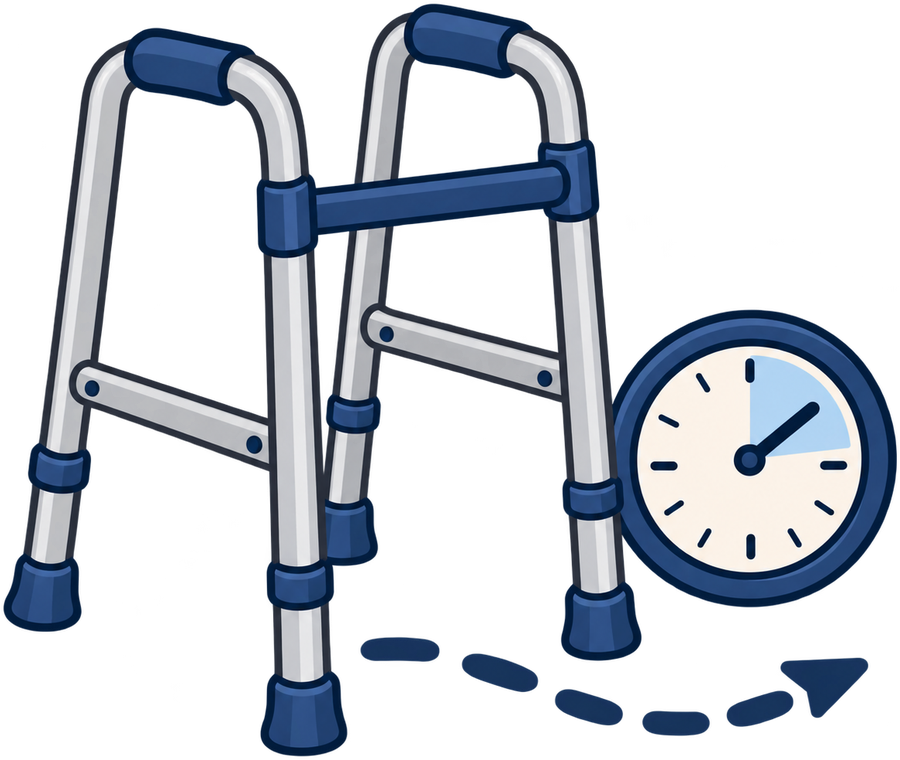
Implementation — carry out the plan
Implementation is when you put the treatment plan into effect.
As the nurse, you are expected to monitor implementation to ensure the patient is following through.



Evaluation — did it work?
Evaluation is the last but in no way least important step.
Compare the patient's actual outcome to the goal you wrote in the planning phase.

Priority-setting frameworks (when in doubt)
Prioritization is the bedside test of ADPIE: the nurse still assesses, diagnoses, plans, implements, and evaluates, but unstable physiology changes the order of action.
On exam questions, avoid choosing a task just because it is scheduled.
- ABCs — Airway, Breathing, Circulation always come first.
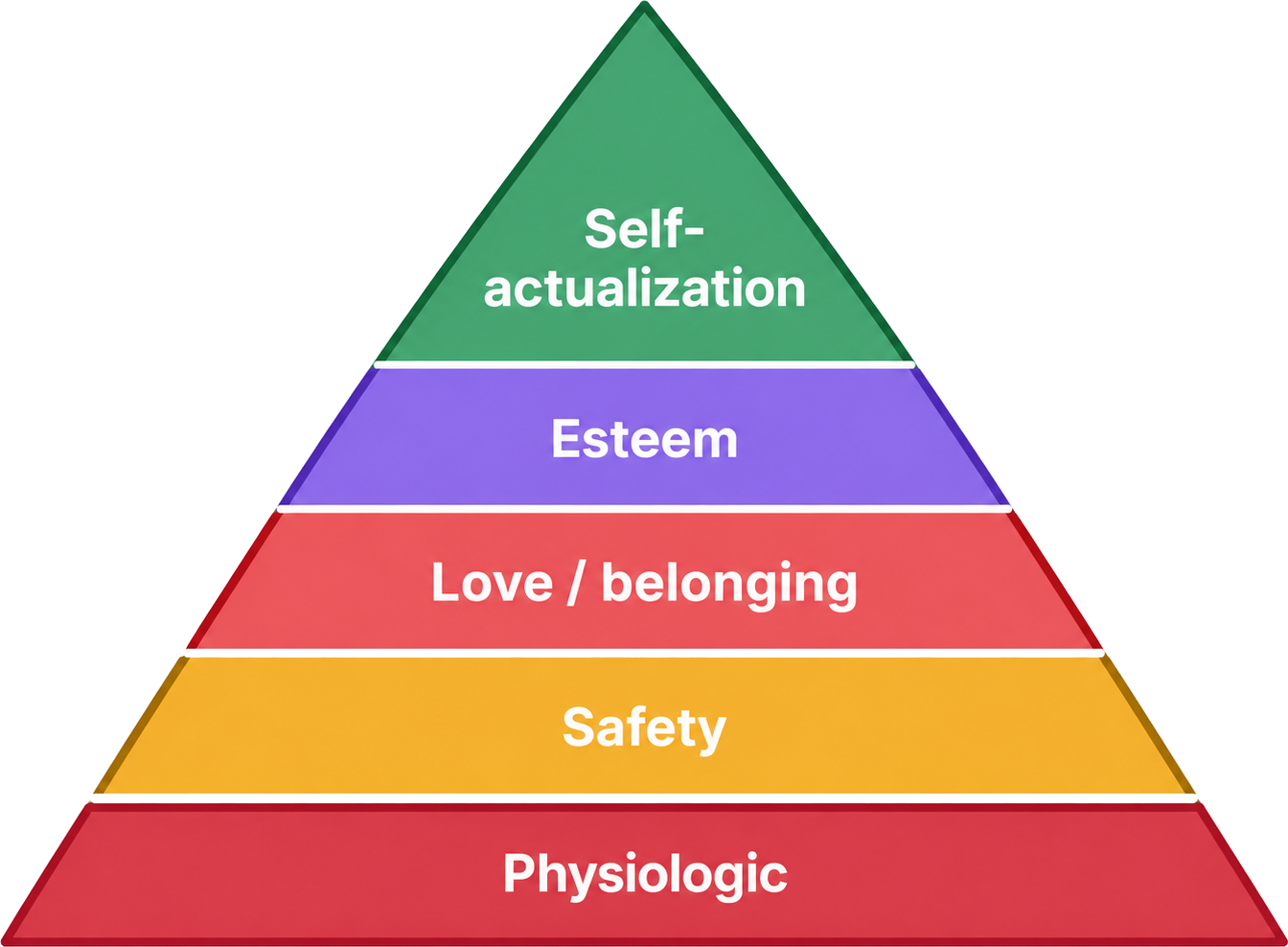
- Maslow — physiologic needs before safety, safety before psychosocial.
- Acute over chronic, unstable over stable, unexpected over expected.
- Safety — falls, suicide risk, restraint orders trump comfort tasks.

Key nursing points
- Always start with assessment — never skip it.
- A nursing diagnosis describes a response, not a disease.
- Goals must be SMART: specific, measurable, attainable, realistic, time-bound.
- Evaluate against the original goal and revise the plan.
- ADPIE is a loop — if the goal isn't met, return to assessment.
Nursing priorities checklist
- Airway · Breathing · Circulation
- Safety / fall risk
- Acute over chronic
- Maslow: physiologic first
Test yourself

Pick your answer first, then open the rationale. Guessing teaches nothing.
The five-phase framework that defines safe, patient-centered nursing care.
— 1 —